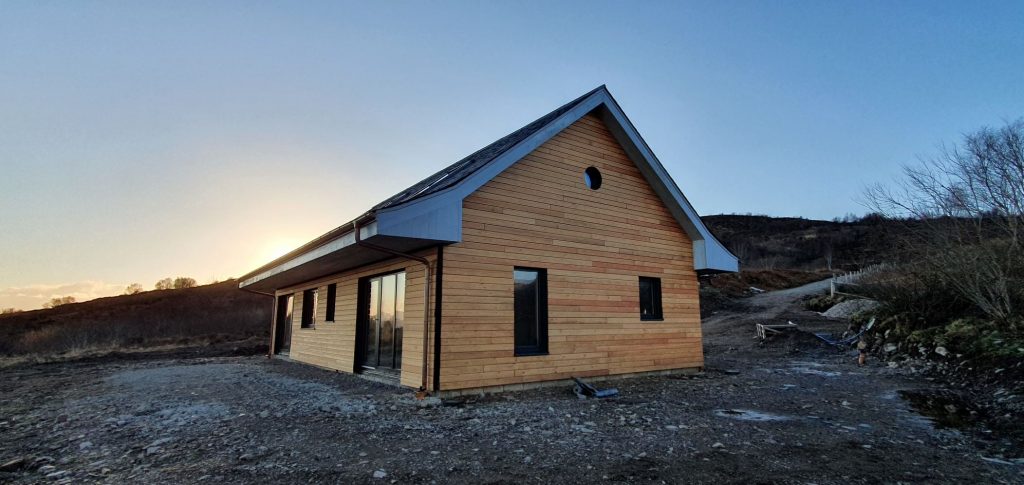
After almost 4 weeks away, the last weekend in February I was back up to the house with a car packed full of tools that would be needed for the next stage of our build: including our own mitre saw, belt sander, circular saw, 600mm long augur drill bits, clamps, step-up platforms, trestles and – so I could put into action my new carpentry skill – a biscuit jointer! First though was focus on utilities.
Moving electricity indoors
We’d decided at the start of the year that as soon as we could we would get the broadband connected. There is absolutely no mobile phone signal on site, and getting connected to wifi has meant walking 10 minutes down the hill back to the cafe. Before we got onto connecting the fibre, however, we needed to bring the electricity supply back inside. And so the electricity metre saga began again.
It had been a slightly protracted, stressful process getting our electricity metre initially installed. This next stage seemed even more complex, as involved having to coordinate three different players:
- SSE to do the mains cabling work, in this case disconnecting the outside supply and then feeding the cable through the duct that had been built into our slab (to minimise any air loss) and reconnecting inside the house
- Octopus contractor, SMS, doing the physical metre move and re-connection
- Our electrician making the final connection, and installing the fuse box, to give us power.
All of these need to be coordinated to happen in the right order on the same day, otherwise you are left without power. As it’s a totally standard thing for every new build having to bring the metre inside the house at some point in the build process, you’d have thought the companies are well set up for it. They’re clearly not. And in a rural remote area like ours, the process just doesn’t seem fit for purpose – and incredibly wasteful in terms of time and resource. SSE and our electrician both were booked in advance, and arrived as planned. The metre move was a different story – but it’s a dull story, so suffice to say that whilst I could have done without the 3 or 4 times I had to walk up and down the hill to have totally exasperating conversations with Octopus, we ended the day with our metre and power supply inside the house, so all was well in the end.
No more isolation (for good and sometimes bad)
By contrast, our broadband connection was a total breeze. Having spoken to Openreach right at the start of the project, it had all been surprisingly straightforward the whole way along – almost suspiciously so. The fact that we’d laid the duct already (at the same time as the electricity cable) definitely was a big relief to the local Openreach team, and so all that was needed to be done by them was to attach the end of the fibre cable to the blue string I’d threaded through and pull, and then they could make the final connection. I was slightly disappointed that I wasn’t around when the cable was pulled through, but Rachel, the Openreach engineer, phoned me afterwards to report that all had worked well!
On connection day, everything also went smoothly, and because Rachel took such care, I felt much more comfortable that a fairly ugly grey BT box was being installed on top of our new, beautiful cladding! (Hopefully a strategically placed plant pot will hide it.)
And so we now have a superfast fibre broadband connection in the house, which feels like a fairly momentous thing. For the first time, we can make calls, get emails and search online for stuff while we’re on site. Of course there’s definitely a downside to that, as one of the things I’ve really enjoyed is the site being an escape from the rest of life, with no phone calls or emails to interfere – the rest of that week the days definitely felt much less productive, with the option to be ‘interrupted’ by comms!
Window trims and biscuit joints
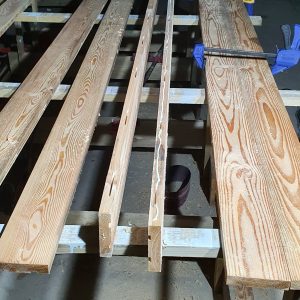
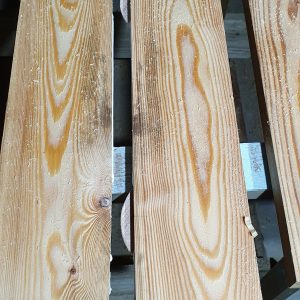
Definitely handy having a brother who has a lot of tools, and more importantly knows how to use them. When I’d asked if he happened to have a biscuit jointer, I did think this might be the one thing that might not be in his workshop: wrong. He’d actually inherited an almost brand new Makita biscuit jointer from his father-in-law, Frans, which I very happily took off his hands for a few weeks. We needed to join two widths of larch together to form the finishing trim for our windows.
Fortunately the biscuit jointer is really straightforward to use – and unlike lots of the mechanical saws, also feels extremely safe as the blade feels nicely tucked away from anything being able to get in its way!
And onto interiors
Whilst we’re still waiting – and waiting – for confirmation of when our blown-in insulation will be done, as I’ll be directly project managing the rest of the house build after that, my attention has now had to move beyond cladding!
As well as talking to plumbers and electricians during the week, the initial part of our MVHR kit arrived on site and so I started to get to grips with how all the ducting needs to be installed. In theory, it seems relatively straightforward. The most daunting part is having to cut 2 x 170mm holes through the front wall of the house (and the cladding) to fit the main ducts through from the MVHR unit. In one single cut, that could be the end of achieving our airtightness target if it’s not absolutely right. Because of the design of our flat roof, there are then another 10 smaller 90mm ducts that have to go out and then back in through our airtight layer, each needing to be separately grommeted at both ends to ensure fully airtight. The reality of achieving what was already an extremely challenging airtightness target (of <0.35) is really beginning to dawn on me. Think will just put my head back down into the sand and worry about that another day.