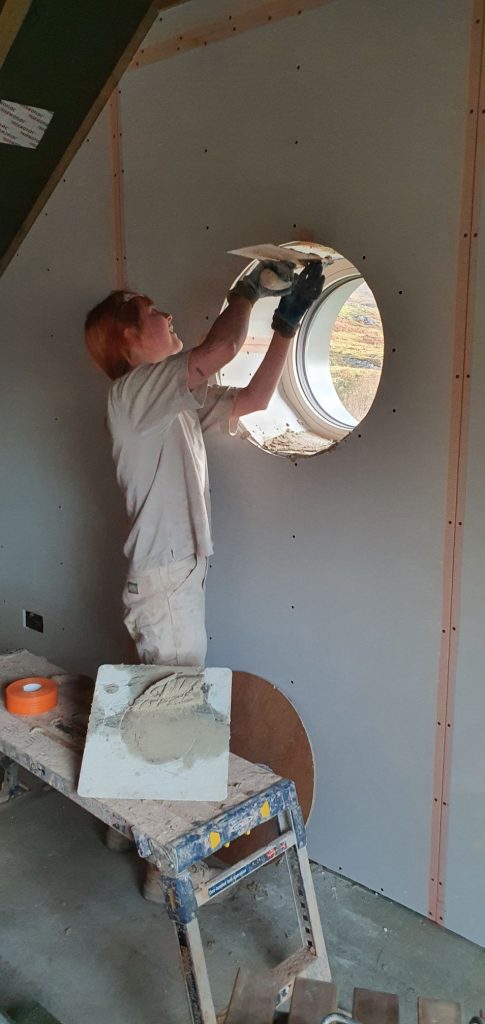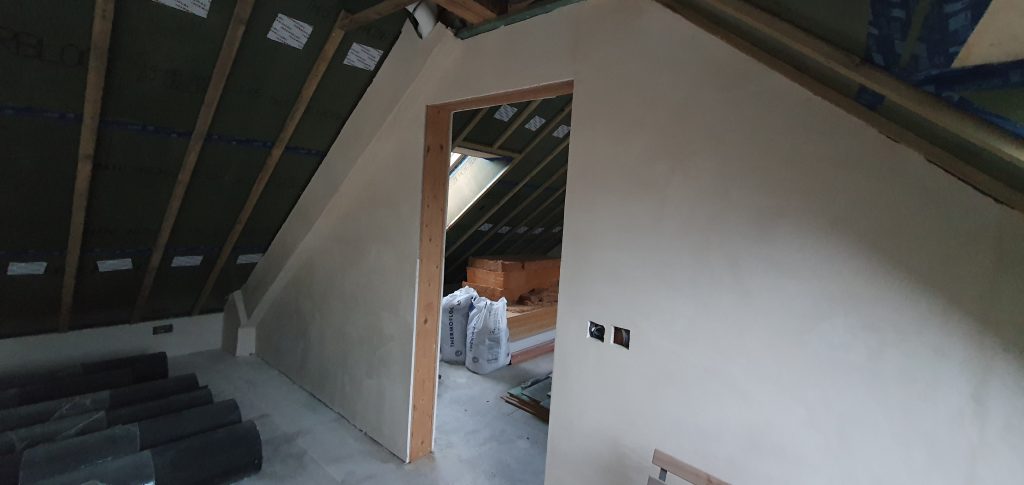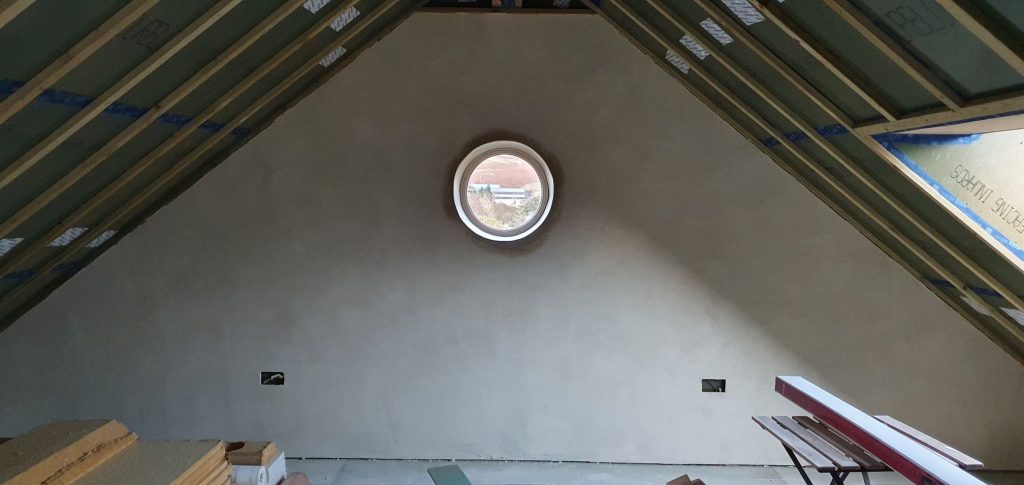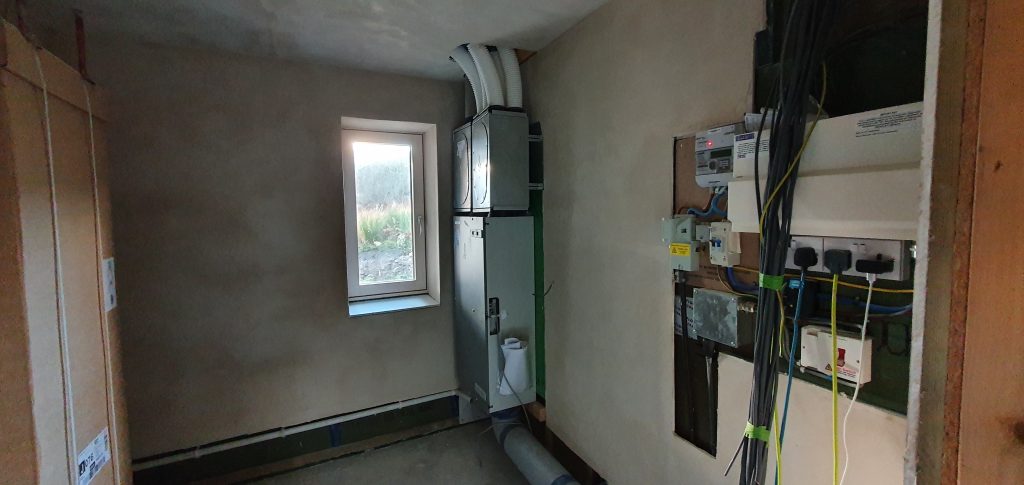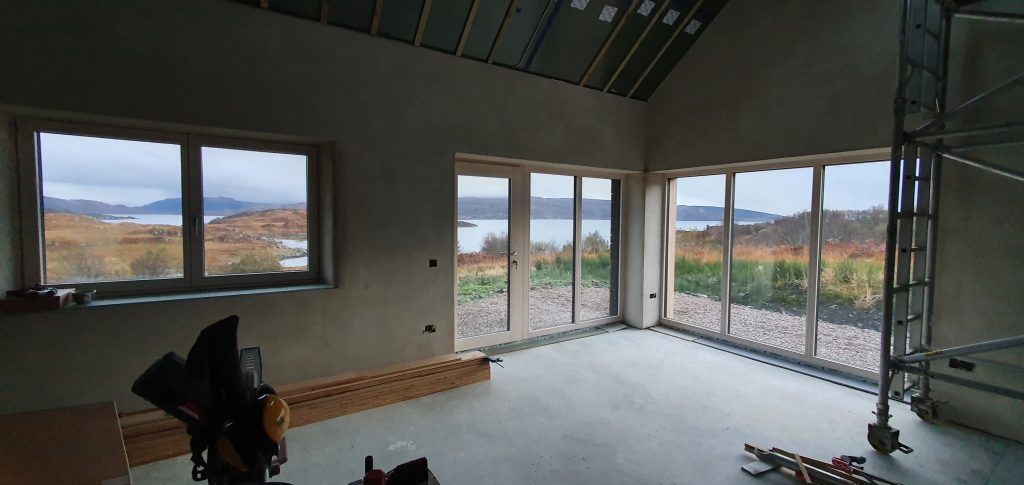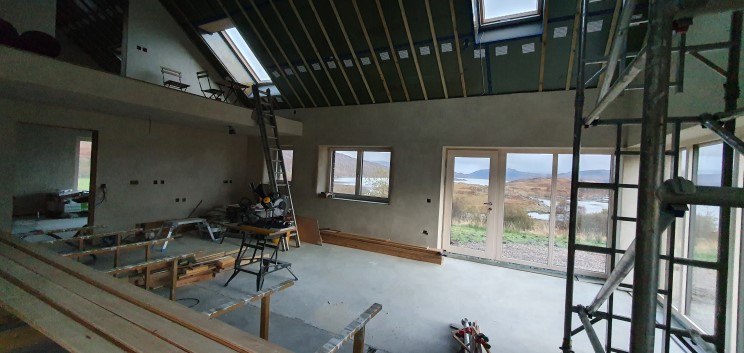
I did very briefly toy with the idea of doing a short plastering course so that I could do the plastering myself. Fortunately I decided to stick with the professionals – helped by Steve’s suggestion that attempting to do it myself was a really bad idea! So instead I got in touch with Gemma – aka ‘Plaster Lass’ – who I had met when she wandered into our COP26 House back in November 2021.
Whilst we only had a very brief and casual conversation at the time about our project in Ardnamurchan, I tucked her email address away in my phone just in case. Gemma had just completed a clayworks plastering course when I met her at COP, and was full of the joy of working with natural materials rather than the much nastier gypsum products. So 6 months later, when I was beginning to think about plastering, I decided to get in touch. Rather than look for references, I trusted my instinct, mostly based on that feeling I had got when we met that values aligned and she would care about the work she would be doing for us.
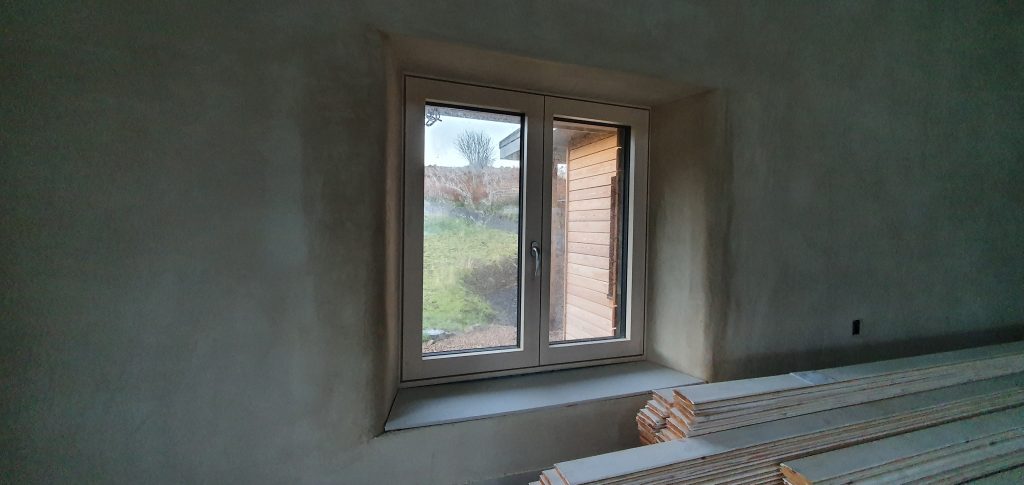
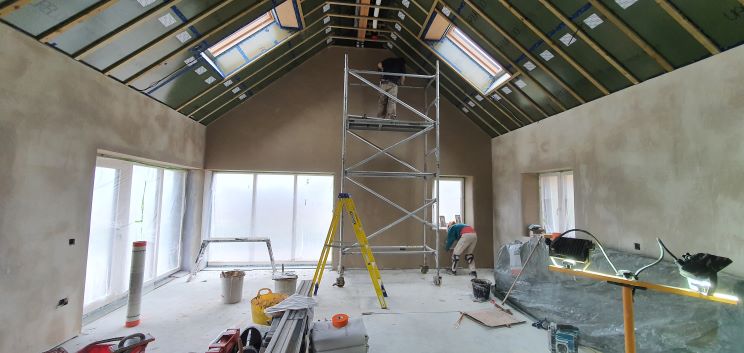
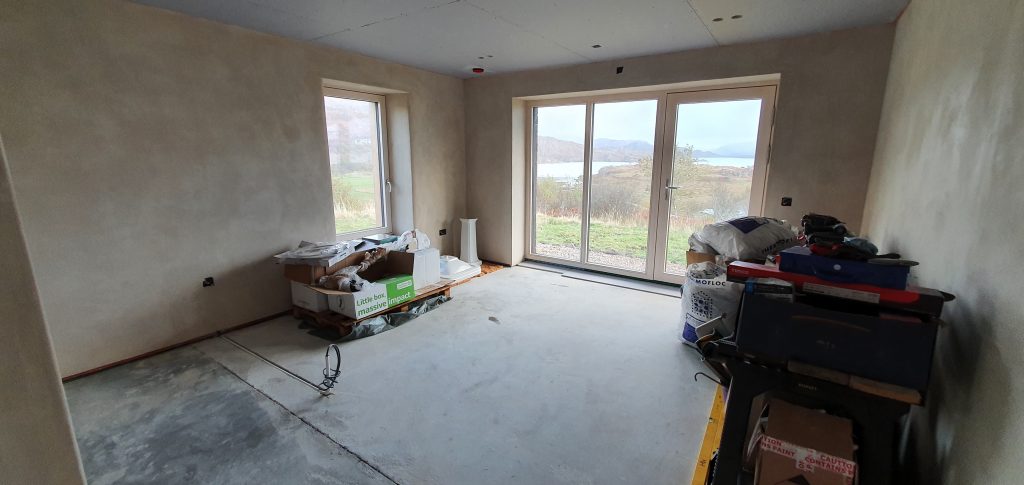
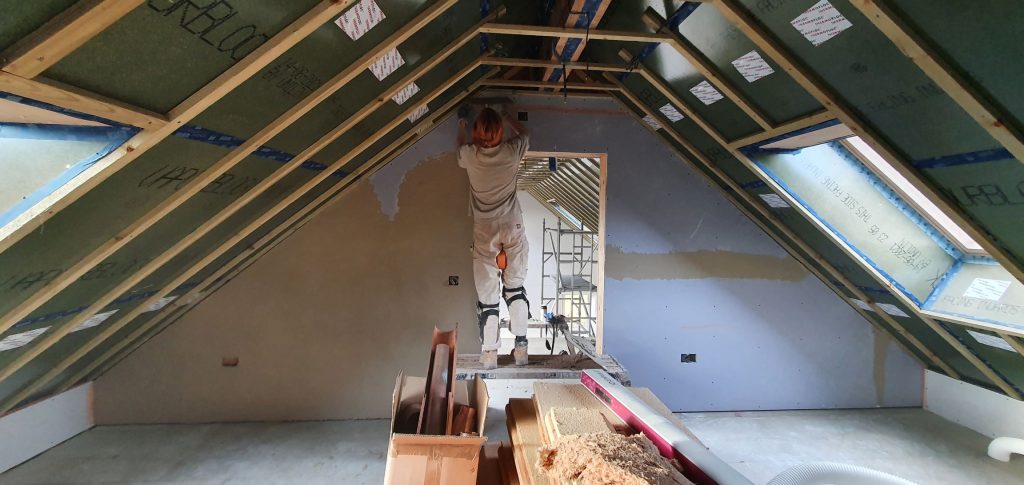
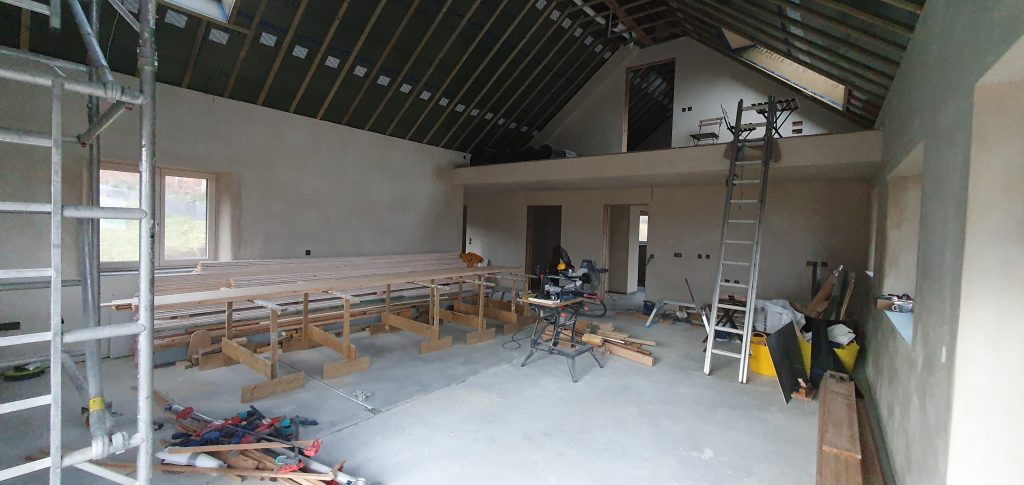
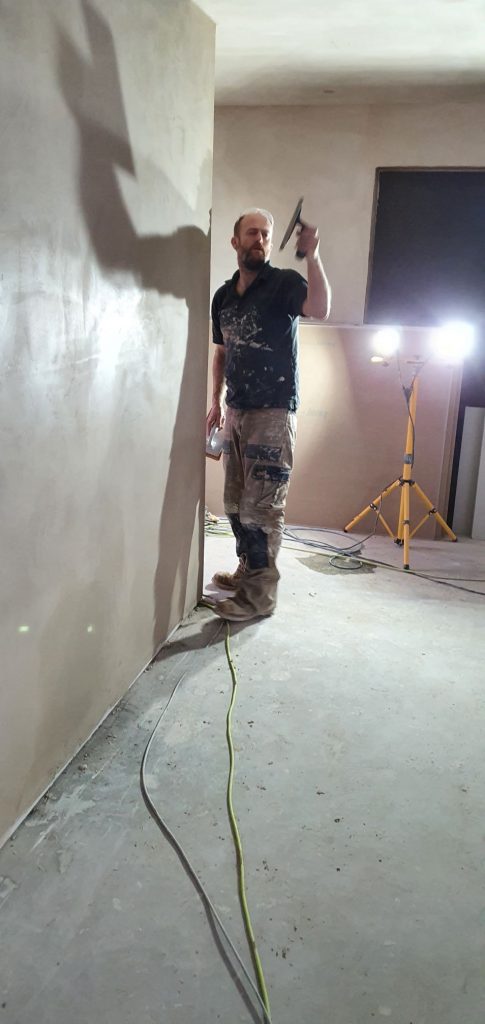
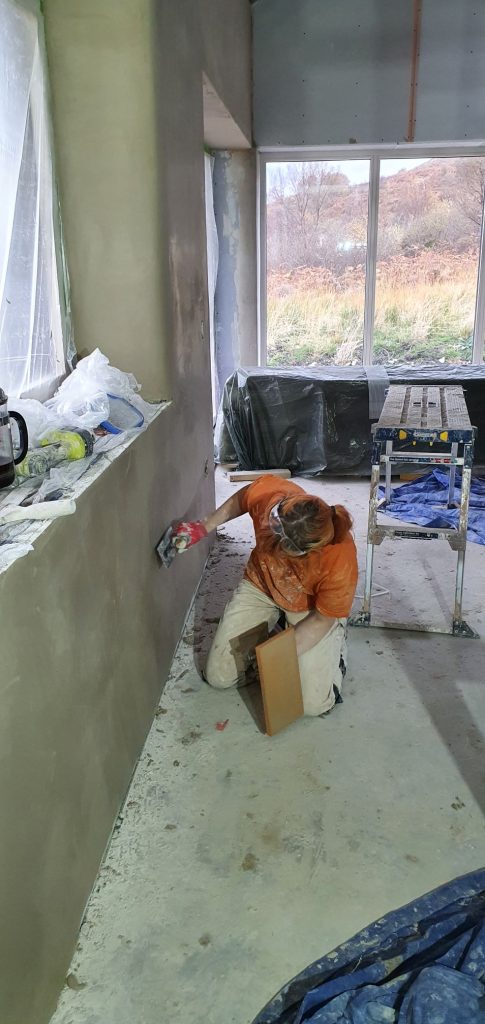
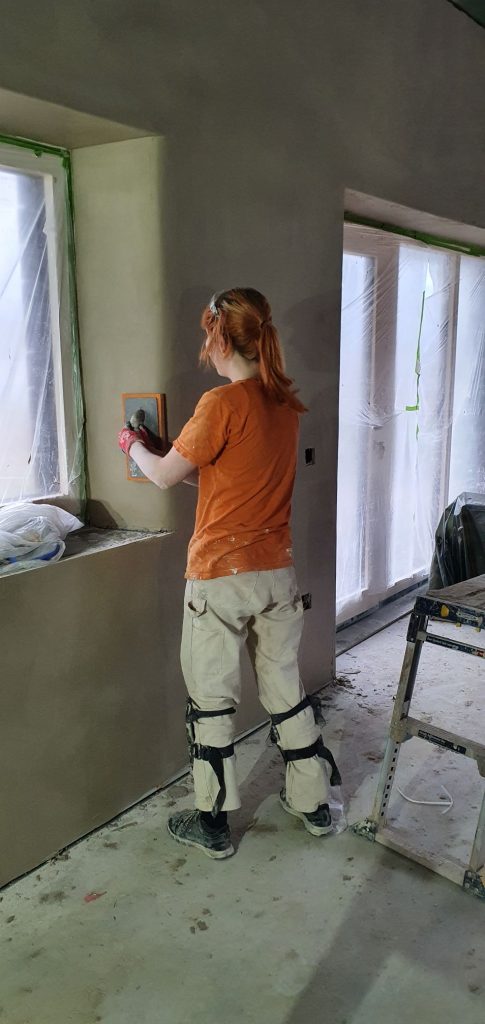
Almost 1 year to the day from when we first met, Gemma and fellow (expert) clayworks plasterer Mal arrived at Saorsa armed with all their kit. I had been warned that plastering was messy – and it really is! But regardless of the mess, it was a really satisfying feeling at the end of each day seeing the house transformed much closer to its finished state (as well as the nasty plasterboard being covered over).
A new lime plaster
Gemma and I had both come across Adaptavate and their new smooth Breathaplasta product around the same time. Their promise is to ‘make lime plaster easy’, with the smooth version going on in a similar way to standard gypsum based plaster – 2mm basecoat with 1mm skim coat. Breathaplasta’s credentials claim “high thermal performance, moisture regulation and acoustic insulation providing better living comfort, with excellent fire performance and a lower environmental impact compared to mainstream plaster products.” Felt like a natural fit for our building.
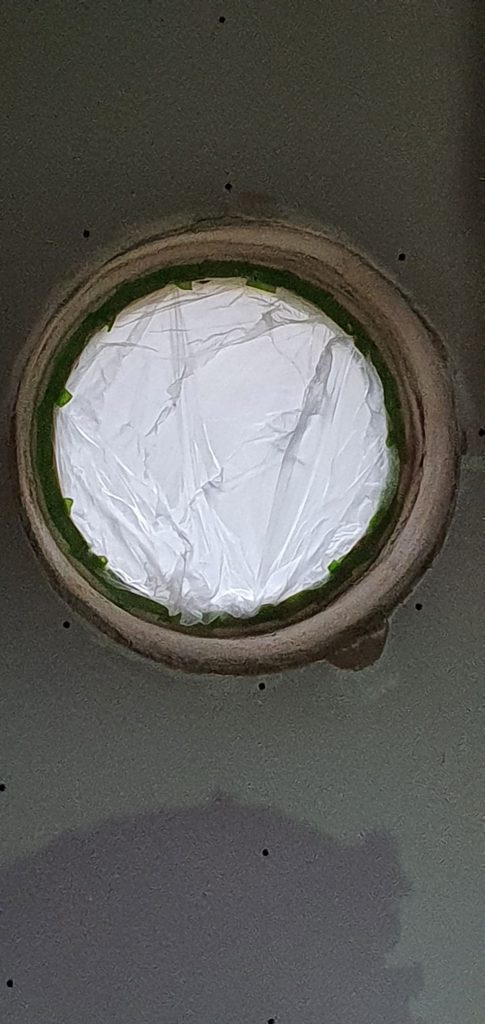
The sense of not doing the plastering myself was really demonstrated in the first few days especially. Being the first time that Gemma and Mal had used the product, it took them a few days to get used to exactly how Breathplasta behaved – the best consistency to use, the time taken to dry between coats, and the differences applying the plaster to the different boards: soundblock, standard and moisture block plasterboards. Turns out that it didn’t really like moisture block boards at all, as something in the plasterboard that stops the moisture clearly reacted with the Breathaplasta causing spots to appear on the surface of the plaster. This was solved by first applying a (fairly violent bright green) plaster primer product and leaving the first coat of Breathaplasta to dry overnight before applying the second coat, so no lasting harm done (and they’ll know for next time). Fortunately we had the Adaptavate team on hand to consult with and advise throughout the week, which was very helpful.
Overall by the end of the week, I think Gemma and Mal both liked the product a lot more than on day one! Whilst I’m absolutely no expert, the main advantage that I picked up that Breathaplasta has over usual lime plasters is that you can apply a much thinner layer of product and it dries quicker (although perhaps not quite as quickly in our house as in more ideal conditions that Adaptavate had tested it in!). Less product has to be better I would have thought in terms of transport, energy used to manufacture etc – but I’d be interested to see the numbers.
Craftsmanship
As with many of the people who we’ve been lucky enough to have contributing to our house build, it was again a real pleasure to have true craftspeople involved and be able to watch them working. Based on the Isle of Bute, Mal has a nationwide reputation for his clay plastering expertise. Gemma is newer to the plastering game, having initially done a fine art degree and only switching to plastering during the pandemic. She is already building up a strong reputation though – well-earned. They also introduced me to a whole load of new different podcasts and music!
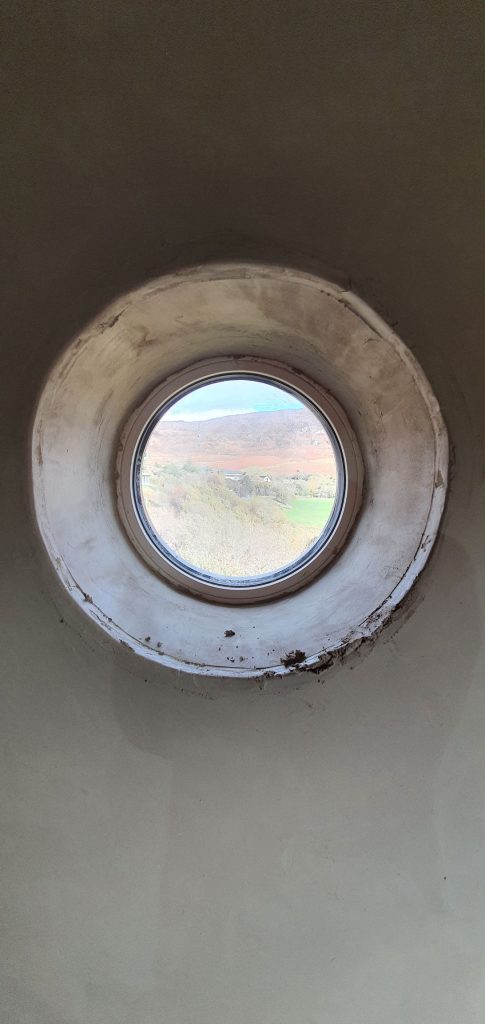
Mal also introduced me to the Japanese philosophy of wabi-sabi . Just google the term and you will find a lot written about it. According to Wikipedia, in traditional Japanese aesthetics, wabi-sabi is a world view centered on the acceptance of transience and imperfection. The aesthetic is sometimes described as one of appreciating beauty that is “imperfect, impermanent, and incomplete” in nature and is prevalent in many forms of Japanese art. This term is very relevant to natural plasters, as they are natural materials that will always have so-called ‘imperfections’ – and it’s about embracing those, not attempting to get that totally smooth, uniform surface.
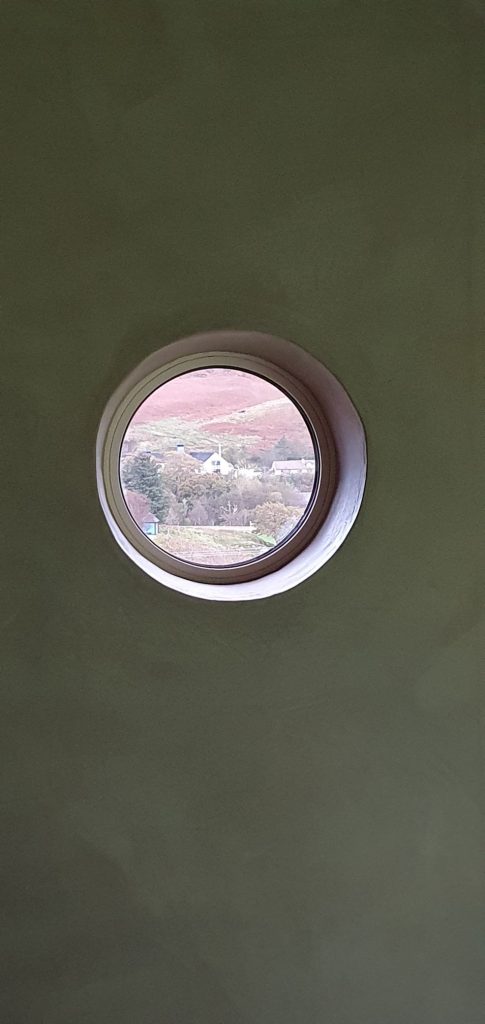
As the plaster has gradually dried out over the past couple of months, these ‘imperfections’ become more apparent. And it has been really interesting to see how different people react to them! Our plan was to hopefully not to have to paint the plaster – simply seal with plaster primer. Despite a couple of people (I won’t name them 🙂 ) suggesting that they thought being able to see some of the tooling and seams would really annoy us, we’re joining the other camp – for now at least – embracing the wabi-sabi view, and enjoying what the variations represent in terms of made by hand with natural materials.
These time-lapse videos are quite fun showing plastering of the west gable wall. (And would have been even better if I hadn’t managed to nudge Gemma’s phone early on in the initial coat…)