I put off thinking about plasterboard for a long time, as I was hoping that some miraculous new product would become available. An alternative that would be low embodied carbon, made of regenerative natural and/or recycled materials, pleasant to use, fully recyclable, and no waste.
There are a couple of alternatives on the market that fit some of that brief: wood wool boards are made of natural materials and are fully recyclable, but they require a greater quantity of products in the plastering process, and unfortunately they are at least 3 x more expensive than standard boards. Fermacell boards were another product proposed to us, and we have used a few of these as tile backer boards in the bathrooms – but at double the price, significantly more difficult to cut and more than double the weight of standard boards, they also just didn’t work for us as a substitute. I read about Adaptivate’s new ‘Breathaboard’, which on paper sounds a really great solution. Unfortunately it hadn’t quite made it to the production line by the time we needed it – if it’s as good as they describe, I really hope it revolutionises the plasterboard sector, but timing just wasn’t right for our house.
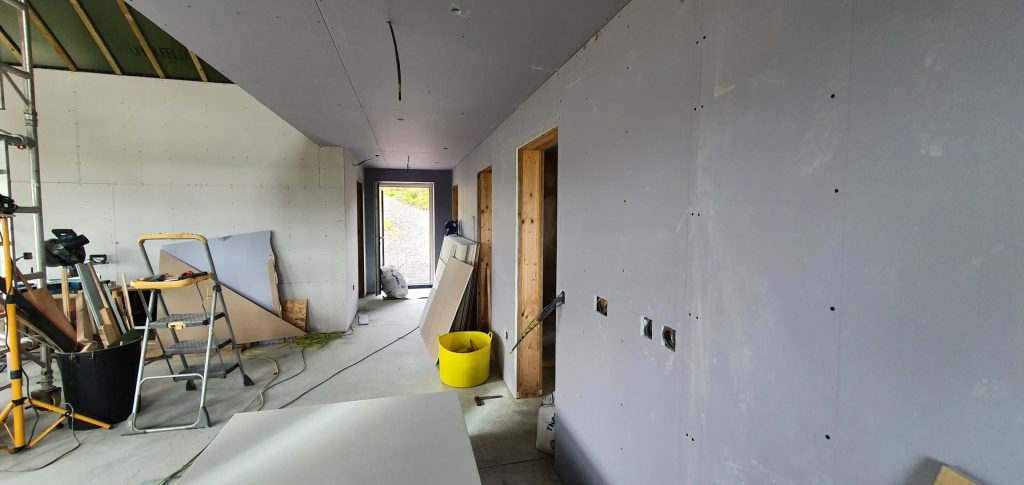
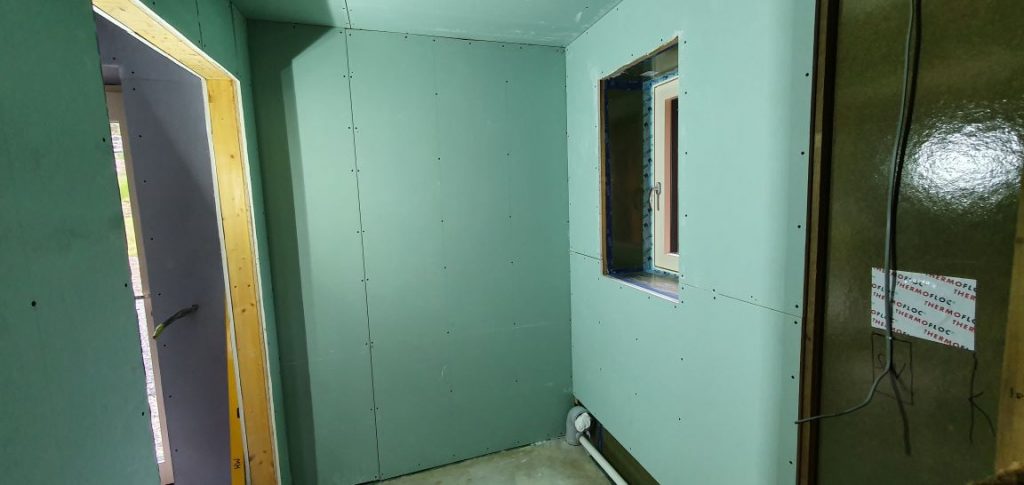
So, plasterboards were ordered: 12.5mm thick white boards (standard), 15mm blue boards (soundblock) and green boards (moisture block). Here are a few things we learnt along the way:
- Plasterboard lifters are essential – fortunately a friend offered us the loan of his, and thank goodness we had it. Every time we cranked the >40kg soundblock boards up to the ceiling using the lift I wondered how on earth we would have managed to do it without it. Not sure I ever quite trusted that the lifter could hold the weight of the board, as I cranked it up to the ceiling but it didn’t let us down.
- Collated screw guns another essential – even at the most modest suggested spacing of screws (and the recommendation for number of screws per board varies massively between online guides I read), you need thousands and thousands of screws. Again, we were lucky enough to be loaned a couple of different guns, different makes – and different quirks – that speeded up the screwing in process massively. Our plasterer (more about her later!) had mentioned to us that the one thing that is really annoying is protruding screws, so we did spend a fair bit of time adjusting screws after the gun didn’t quite fire correctly.
- Plasterboarding is exhausting – and difficult enough with standard boards to do by yourself, but totally impossible if you’re using soundblock boards! We got most of the walls and ceilings done with two of us, and Steve’s son James also joined us for a few days, which was massively helpful. But I then had another two weeks of finishing off by myself before the plasterers came.
Memorable moment when I decided I’d try to get the utility room ceiling boards up by myself (and without a lifter, as that had gone off site by that stage). They weren’t full boards, so I thought I should just about be able to manage, using the water tank box to help support the board in addition to my head… Literally just as I was doing this balancing, and wondering if this really was a good idea, I heard the front door open and one of my neighbours, Nick, came in – and he happened to be wearing his ‘Star Helper’ t-shirt. Absolutely perfect timing needless to say! - Use soundblock board mindfully – it obviously makes absolute sense to be blocking sound between rooms, and I’m sure soundblock board does a much better job at this than standard plasterboard. But it is exhausting stuff to handle – lifting and also fixing screws is so much more difficult and the waste from off-cuts also double the weight. I could just about manage handling half a board by myself, anything more was impossible.
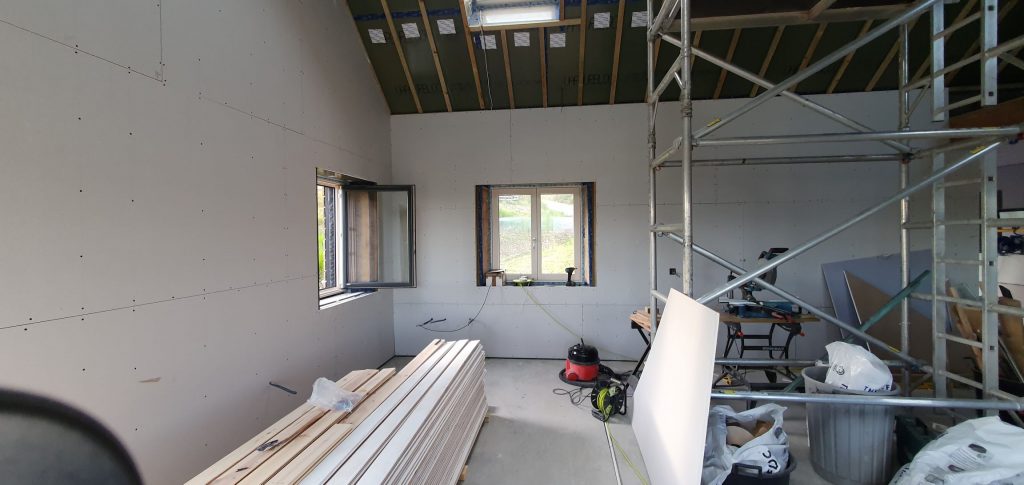
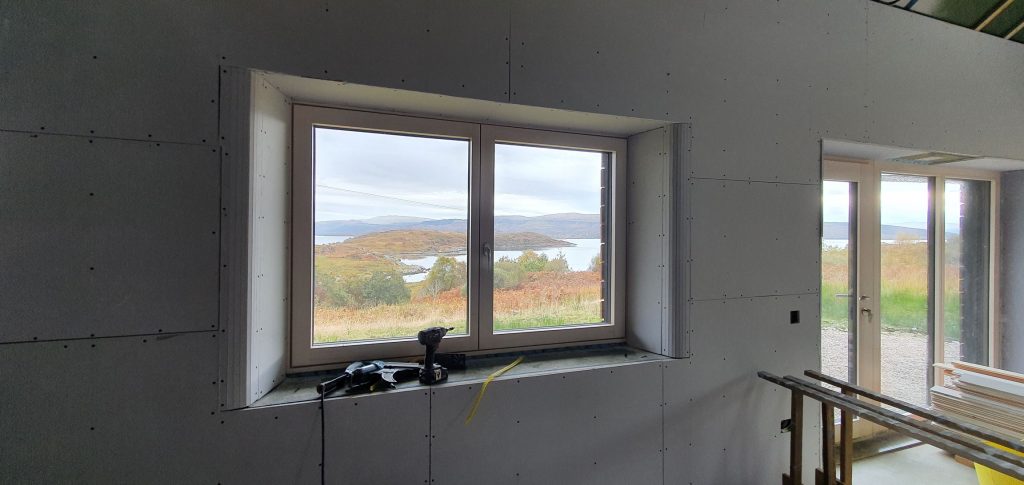
Our original specification was to put soundblock everywhere, apart from bathrooms. However, given the thickness of our exterior walls, and the fact that we’re not exactly positioned in a high traffic area, we decided (mostly based on cost at that point), that soundblock boards weren’t necessary on all the external facing walls. I’m so glad we took that decision, as would have felt like a bit of a costly over-specification to have used it, and also made an already fairly exhausting task that much more so. - Doing curves using plasterboard are not straightforward! I watched a fair few videos of people bending plasterboard, but none in quite the same way that I needed to do it. Despite following the dampening/waiting/dampening again/waiting/dampening for a third time/waiting guidance, because of the nature of the curves we needed for the window sides, even using contour board wasn’t a success using the dampening process (although I’m pretty sure I could now do a full curved wall!). In the end – and each window took me several hours – I managed to get a good, well supported curved window reveal using a double layer of 6mm plasterboard scored on the outside.
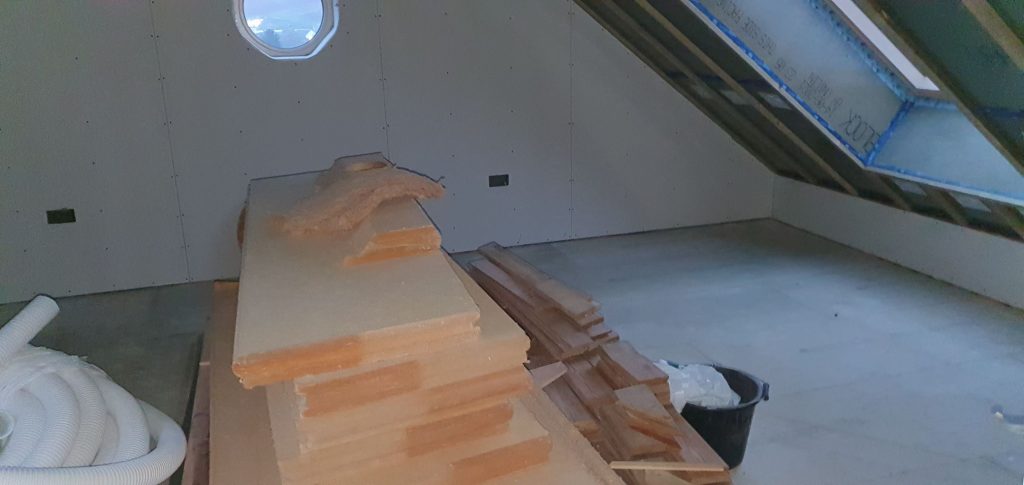
The round window was much less difficult, mostly because the shape of the window was still relatively hexagonal after the plasterboard was fixed. The plasterers gradually built up a lovely smooth circle with plaster.
Despite the time needed to create them, the window curves are fabulous. Very pleased that I invested the time – but on of those things I’m glad I did myself as would have been pretty expensive to pay someone else to do, and not sure the average builder would have invested quite so much time (understandably) to getting them ‘perfect'(ish).
- There is way too much waste during plaster-boarding – and it’s not an easy product to dispose of. Just by nature of the process, and that internal walls will never simply be a multiple of 2.4×1.2m whole boards, there are a massive amount of off-cuts. Not only is this a waste of materials per se, it’s a nasty material (nothing like all those lovely natural materials of previous stages). In areas where councils are still using landfill, if plasterboard is just mixed with standard rubbish, there can be some fairly unpleasant impacts of this. Also the costs of disposing of it can be more per equivalent sheet in some councils than buying a brand new sheet in the first place. This is another area where there would be big benefits from off-site manufacturing.
- I never want to be a professional plaster-boarder – in our first couple of very slow days of plaster-boarding, my brother encouragingly told us that professional plaster-boarders put up more boards in an hour than we had done in a day. And we were only a bit quicker by the end! Happy to leave the skilled people to this job.
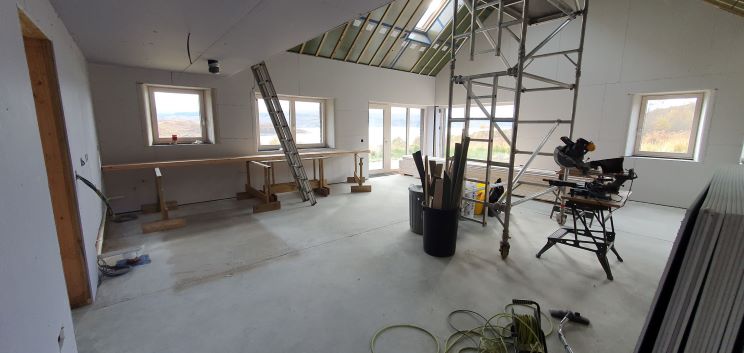
As everyone had said, once the house was plaster-boarded it really did begin to look like a house rather than a building site. Very relieved to have it done. And really hope if I ever have to do this type of internal boarding again that there is a better product to do it with.