
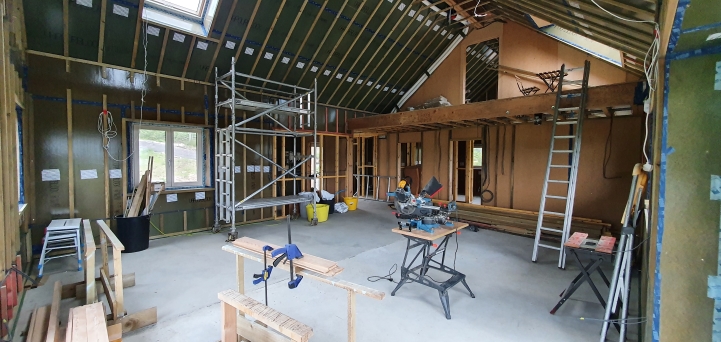
The day finally came on 5th July when the precision of the build was put to the test: the first airtightness test. This isn’t the official test – that will be done towards the end of the build. But this initial one is carried out at this point before everything is covered up so that it’s easier to discover where any gaps are and to rectify them.
I probably should understand the physics more. The official language: the target for Passivhaus is 0.6 ACH (air changes per hour) – which refers to the number of times an hour that the air in a building changes when it is pressurised. In simple terms, the principle is to ensure that there aren’t any gaps or cracks in the fabric of the building that could leak heat out, or let cold (or hot) air in. 0.6 – very roughly – equates to a hole of 6cm x 10cm across the whole building structure, or leakage of 1m3/hour.
To put these numbers in context: the major UK house builders have ensured that there hasn’t been any reduction in the 2005 standard required for airtightness of 10m3/hour – despite the fact that they know a house achieving 5m3/hour would require 40% less energy to heat it. Way back at the beginning, in my second blog post I talked about what had ultimately persuaded us to go the Passivhaus route – with the waste of energy through heat loss being a major driver, as well as the health and comfort factor. The current energy crisis has really focused minds on the importance of reducing energy needed to heat our homes, so have to admit it feels good that our house has been future proofed in this way! Our house aside, with that huge difference in energy requirement, just imagine the huge reduction in household energy bills if all new houses in the UK were built to Passivhaus standards, seems such an obvious thing for the government to be pushing for. But back to our own house…
Every stage of the build has required precision in order to ensure no gaps, and then the final critical part for airtightness is taping. I knew those years of spending a lot of time wrapping presents would be good practice for something! Initial taping was done by the Faryma team, but over the past couple of months I’ve spent a lot of hours/days and used a lot of rolls of various types of special Pro Clima airtightness tapes in an attempt to close off every gap in the building, no matter how small.
We have a few factors stacked against us for achieving the optimum result, with airtightness and the Passivhaus standard generally:
- our house form factor is not ideal for Passivhaus. It’s small, detached and we decided from the start that we wanted a double height space. What this has meant is that we have a lot of outside walls relative to the amount of usable floor area we have inside, plus a large double height space to heat. This negatively impacts our Passivhaus scoring.
- our location is slightly challenging (which is ultimately why we love it!) – the Passivhaus scoring incorporates a weather data set, and let’s just say that Ardnamurchan isn’t the easiest location to achieve the standard weather-wise
- and location related, our kit was subjected to plenty of weather during the build. Being made of timber, there has definitely been lots of movement which in turn has likely affected the precision of the joins, especially the main ridge beams.
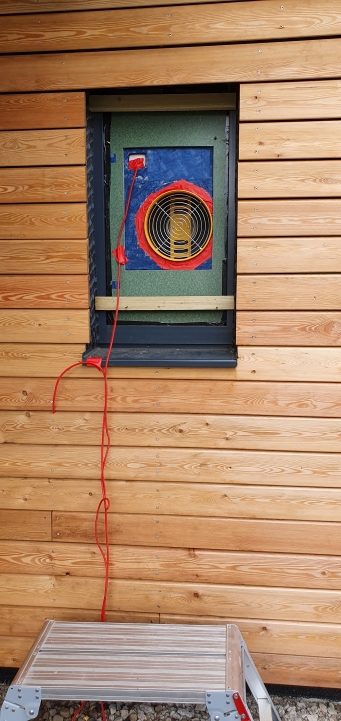
And so to testing day: expert airtightness tester, Paul Jennings, had made the journey up by train from Cornwall, together with his fan and other measuring kit. The fan was secured and sealed (more tape!) into one of our small side windows. Once it was turned on, the fan gradually sucked the air out of the building, enabling the airtightness to be measured. Because of the air pressure, all the gaps and cracks were easy to locate as these were accentuated. Paul also went round the house with a thermal imaging camera to help locate any areas of concern, although this would be more effective in the winter months when there is a bigger difference between inside and outside temperatures.
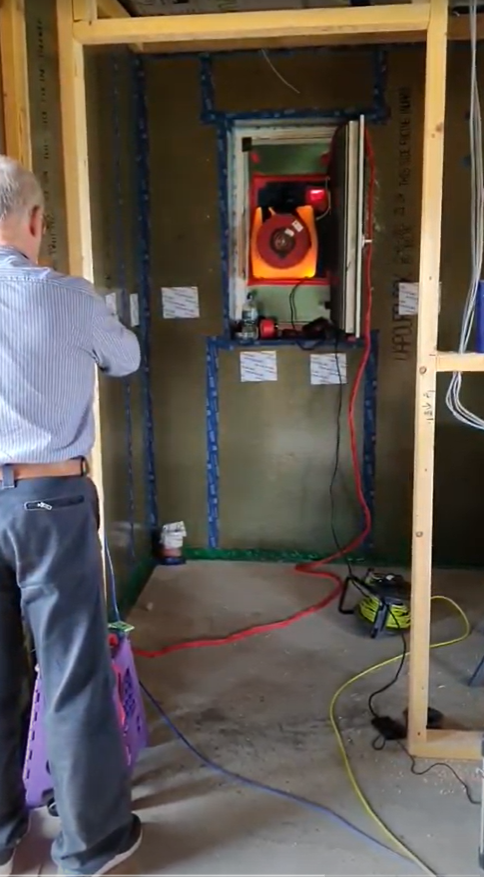
And the result: our score was a very decent 0.67, but not quite good enough for Passivhaus certification purposes. A few things we can do to improve – adjusting a couple of the windows and doors, a bit of additional taping around a couple of windows, and – likely the main one – taping the main ridge beam along the join between the two beams, at each side where it meets the internal wall, and at the ends where it disappears into the wall. At the end of the day, small differences in scores will make very little/any difference to our experience living in the house, either cost of energy or comfort, but having invested so much effort into making the house as airtight as it already is, worth making this last final effort to see if we can get below 0.6.
First Fix Plumbing and Electrics
Over the past couple of months our electrician, Neil, has been working away on getting the first fix wiring done. Last week he was joined by Nigel, the plumber, along with his young apprentice, Alex. Whilst I had contacted them separately, turned out Neil and Nigel had known each other for a long time – and both variously worked for Roderick (James) on the numerous houses that Roderick has built over in Morvern. Once again, it was a pleasure having highly skilled people working on our house, genuinely taking care with the work they were doing.
I’d spent a little while a few weeks before attempting to work out all the places that we would need sockets around the house, plus where we would want to turn lights on and off. Makes for a lot of wire, but there will be nothing more annoying than doing all the wall finishes and then realising that should have put in an additional plug socket or light switch.
For the lights themselves, I’ve been fortunate that through my involvement with the COP26 House I had been introduced to Orluna lighting, and one of the Orluna team helped with the lighting design for the house. As well as being extremely high-quality lighting, Orluna have also been working really hard on their environmental impact, looking at this across the whole product lifecycle. The lights themselves arrived on site last week, and the attention to detail they’ve applied was very evident as soon as I opened the boxes: it was such a pleasure seeing products intelligently packaged using the minimum – brown paper – packaging required to protect the products, and with not a hint of plastic in sight. Let’s hope more manufacturers follow the Orluna example.
With Nigel installing the pipework, I’ve also had to turn my attention to the plumbing side of things, and attempt to work out exactly what showers, basins and toilets we want. Until this moment, I’ve been focusing so much on the construction side of the house, now switching to aesthetics is a bit of a shift! I’m slowly getting there with the bathroom stuff though, and at least have made sufficient decisions to enable Nigel to install all the relevant pipework. I’m also pretty chuffed to have found a whole load of the products I wanted through Facebook Marketplace for a fraction of the cost of brand new stuff. Seems like lots of people change their mind about products just too late in the process, at the moment when the items aren’t returnable. Nothing better for minimising the carbon impact of our house than incorporating ‘upcycled’ products – and works well for the budget too!