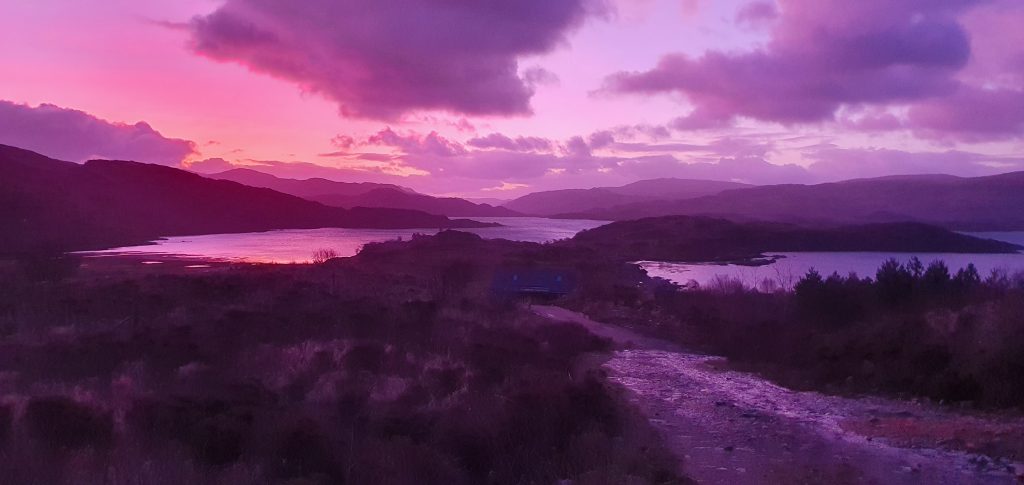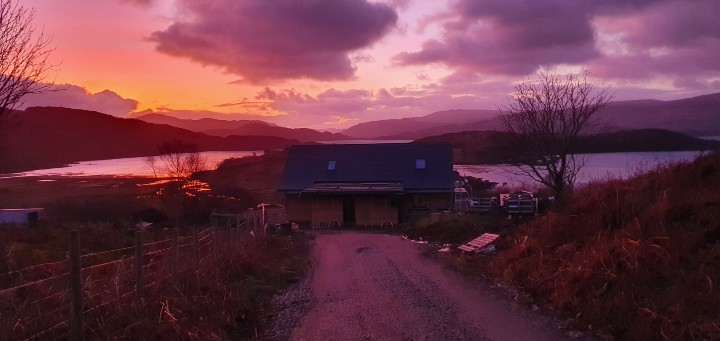
The idea had always been that we’d take a bit of a break after Christmas, and re-start in earnest once the days were beginning to get slightly longer and importantly the weather slightly less hostile. As it turned out, January was a full month on site for the builders, and I was up for two additional weeks getting the cladding to a decent stopping point.
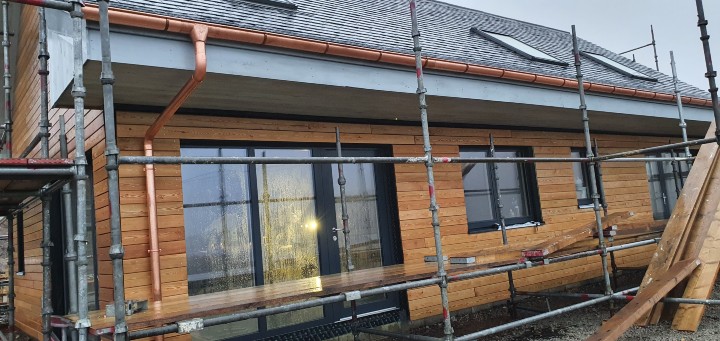
I was once again very glad about our roof shape – and not just from an aesthetic point of view. The nice wide overhangs provided great protection from every type of weather – even in severe wind and rain, as long as you choose the right side of the house, you can work outside all day and keep relatively warm and dry.
More cladding
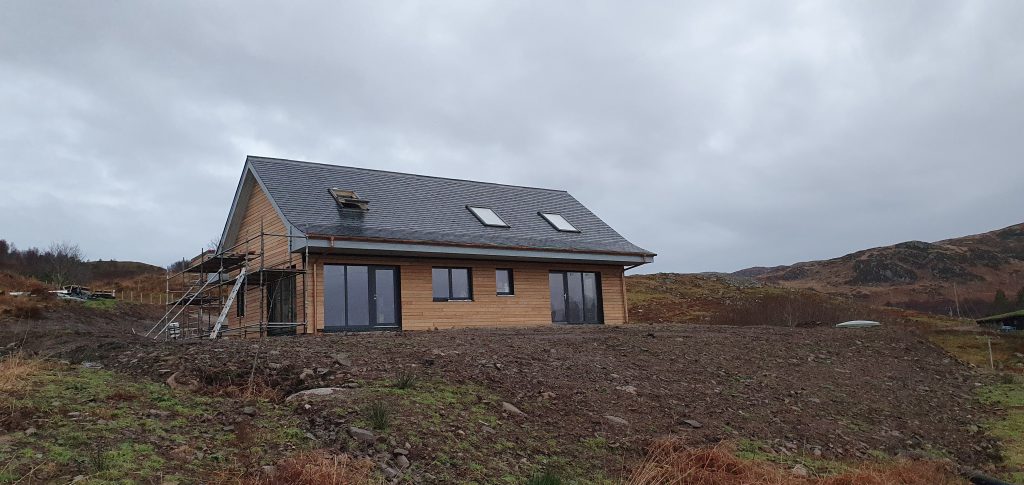
Having (slightly triumphantly) finished the high cladding on the eaves and the South side, there was still a lot more to be done, but fortunately all slightly more straightforward than cutting and fixing angled eave pieces at height. The next trip was focused on the north side: shorter lengths, lower heights, easy peasy… This much more straightforward stuff was also the cladding that would be most visible to everyone. When you’re standing right next to the cladding, looking intently at it for days on end, every half millimetre difference in the gap between the boards feels massive. And with Steve not there, I knew it also had to withstand future scrutiny! Those 18 rows of cladding either side of the front door were fairly stressful – and I’m fairly sure there will continue to be some readjustment.
My final weekend in the intensive cladding phase also happened to coincide with Storm Malik. After an overnight trip to Glasgow, when the worst of the winds were blowing, I arrived back in Ardnamurchan on Saturday lunchtime to a 36 hour power cut. Fortunately I’d charged up my power tools before I’d left for Glasgow, so at least I could keep on with the cladding until the batteries ran out on all of them. Whilst one night in the caravan didn’t feel too bad, as the sun set on Sunday, I have to admit I did like seeing lights appear from houses across the bay showing me the power had come back on.
Another storm arrived on the Sunday evening, and as it carried on across the UK throughout Monday, I decided to delay my trip down south by 24 hours. This also meant that I could pretty much finish all the cladding that I was able to do. It will still take a lot more work – both the trim around the windows and on the corners, plus the tops of the walls, which will need to be cut down height-wise (once I’ve mastered how to use a table saw!) – but at least almost every wall is now protected from the winter weather.
The storms were also a really good test of the house, before we left it locked up for a month through February. The one thing that failed was a broken catch on one of the skylights, so when I arrived back Saturday morning one of the south facing skylights had come open. Fortunately it could be braced closed for the time being until we can get it fixed. The boys had also been busy taking down most of the scaffolding on the day I’d been away – and the rest went the following week – all the better to see our lovely cladding!
Soffits, fascias and gutters
For the builders, they were also on to the more decorative stuff, albeit also very functional.
This was the first time probably since before the build began that I started to really think about the aesthetic of the house. For months of the build, the focus is totally on structural elements, and throughout the Autumn months, (for me anyway) it was 100% about wanting it to be protected from the weather. But walking away from the house one evening – probably after I’d put up a slightly imperfectly cut and spaced cladding board – it dawned on me that visitors to the house never really consider the internal structure, everything is judged on the aesthetic. In time, I guess I will too!
Fortunately this is where the expertise of architects really comes in – as they always have the whole house vision in their mind. So when we had to start thinking about what to do about soffits and fascias (to be honest, previously I didn’t really know what either a soffit or a fascia actually was) , a quick call to our architect Peter pointed me in the right direction and some Sadolin Superdec paint was ordered (Monaco for soffits and Asteroid for fascias).
It of course definitely wasn’t the ideal time of year to be painting but with a couple of heaters running intermittently in the house, between us we managed to get at least an initial coat of Sadolin paint on the boards inside, and we’ll do second and possibly third coats ourselves once the weather warms up a bit.
The next part of ‘decoration’ was the gutters. I’d first come across copper gutters on the COP26 House. Initially I thought they would be way out of reach financially, but having read up a bit about different gutter materials, copper scored really well from a longevity point of view, especially in our location with sea air. At the end of their guttering life, copper gutters are also fully recyclable, and in absolute cost terms, the premium in price over the original alu-zinc product that had been specified wasn’t that much. Slightly less satisfactory from a measurable sustainability impact point of view is that the manufacturers can’t tell you the proportion of their raw material that is recycled vs freshly mined copper – one manufacturer stated that it could be anything from 50-95%, and the other manufacturer just didn’t have any idea. (And yes, I am following up with them both to press them a bit on the importance of having this information, to measure scope 3 emissions!). We are very happy with how they look though, both in their fresh shiny state and as they begin to age through to that lovely green colour.
Oak posts
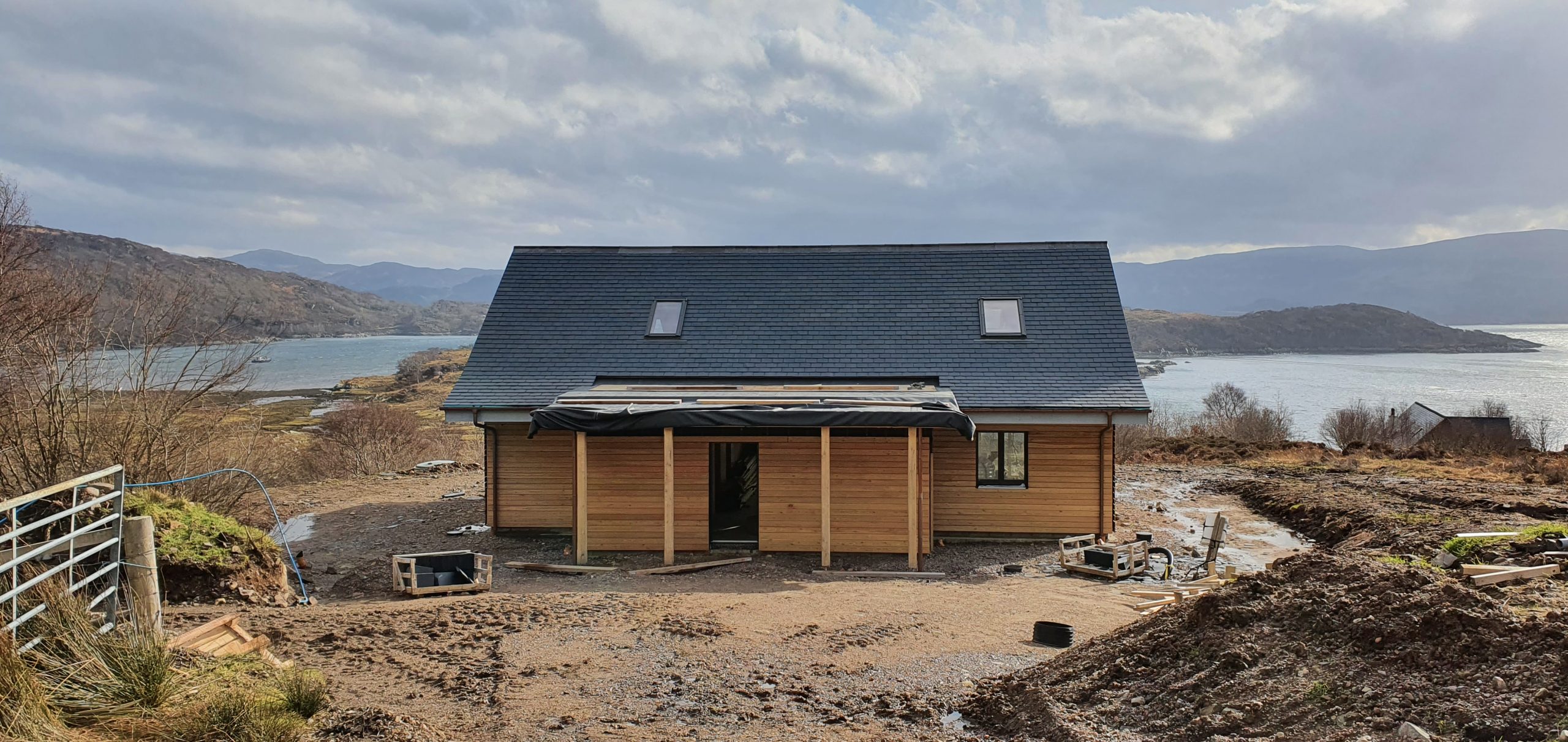
The next – and final – construction piece in terms of the exterior of the house itself were the oak posts at the front of the flat roof. Slight (!) frustration for the builders when, having put the concrete blocks in before Christmas to support the posts according to the spacings on the drawings, unfortunately the manufacturer of the hidden gutter in the flat roof hadn’t followed quite the same spacings and so the drainpipe holes didn’t match up with these positions. A lot of digging out, shuffling and re-levelling of blocks then followed, to move the outer blocks 200mm away from their original location.
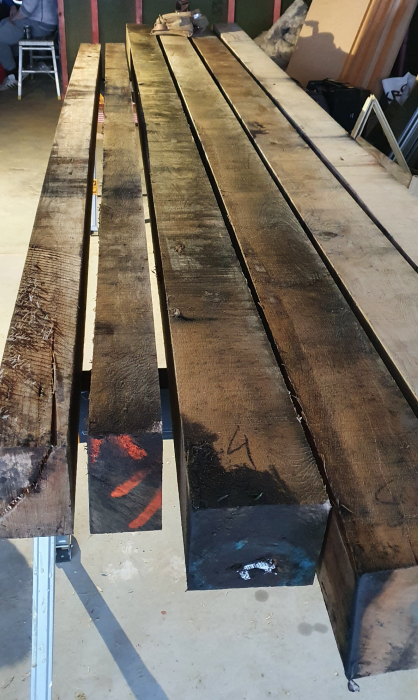
Then to the oak posts. And another big lesson for me. I was asked the question: would we like off-saw or dressed oak for the porch posts. I did check with Peter, and we both agreed as these were going to be outside, subject to weather, we didn’t need an ultra smooth finish and any dressed oak would likely look like off-saw within a year anyway. I guess the answer though is it depends where the off-saw posts come from, and where they were stored once they were sawn! Below is a picture of the posts when they arrived: let’s just say they were a lot rougher looking than everyone expected. Plus they arrived in very random lengths, not totally straight and therefore needing a lot of attention from Michael to make them look good. He really did transform them though.
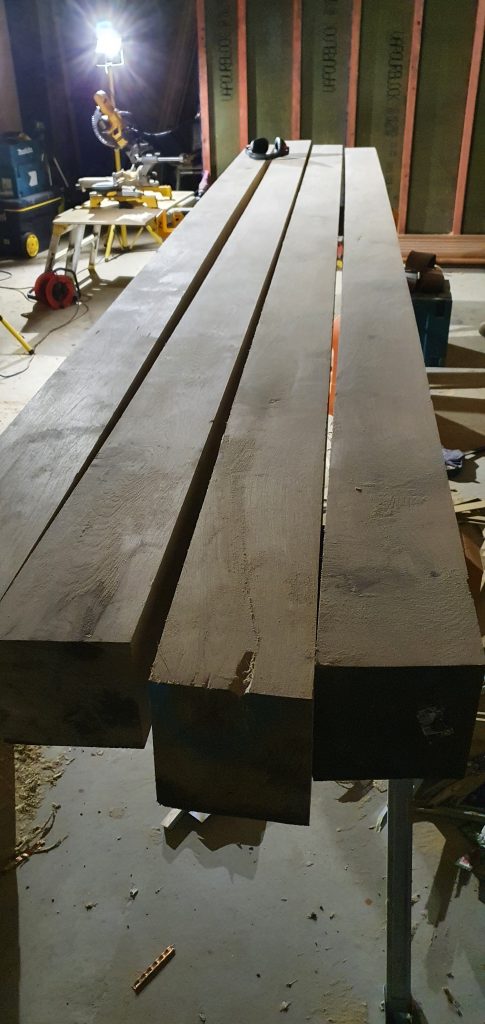
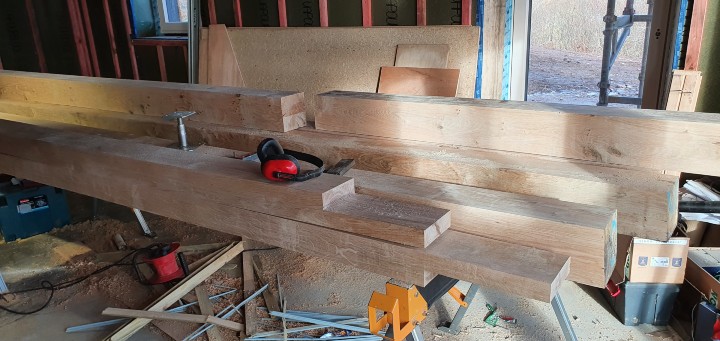
This last week in January was also the last proper week that I’d spend with our builders on site. There remain a few bits and pieces of things to tidy up, but virtually everything is done from the Faryma side of the build, apart from the air tightness test. Not quite sure, being the total novice carpenter that I am, how I’m going to find being without carpentry experts on hand all day to ask advice from. Having someone like Michael Faryma around, with his decades of expert carpentry experience, has been a real privilege. But not just Michael, I have learnt so many things from every member of the team. And I feel very fortunate that they have tolerated me on site so patiently, especially asking so many questions, and for Steve’s calmness throughout. I like to think that sometimes I was vaguely useful in return – at least for my interrogation of every detail of the PH15 plans.
So we’re waiting for two consecutive days when the flat roof covering and fascia boards on the flat roof section can be finished. And then it’s installation of blown-in insulation before we have our first airtightness test. But before that, the house had a month of total quiet during February – and given the weather that Ardnamurchan had during that month, we timed it well!