
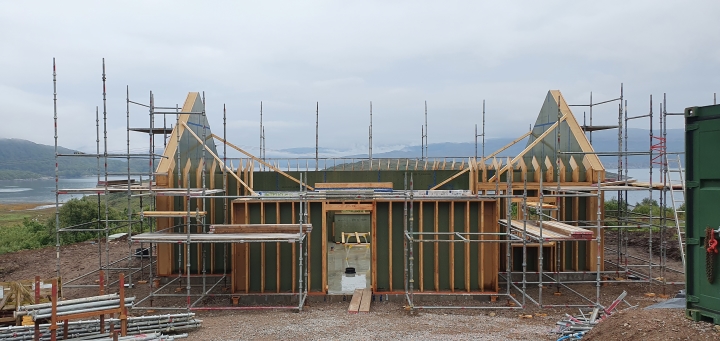
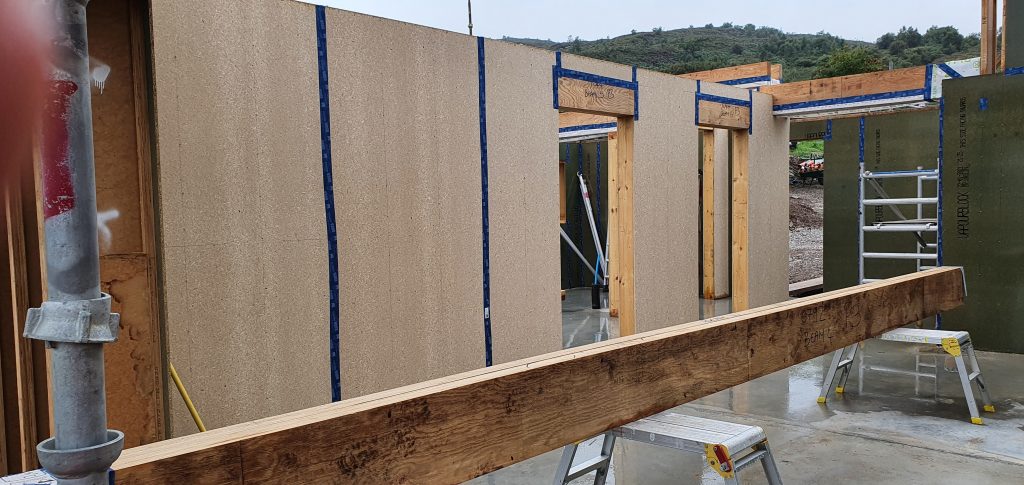
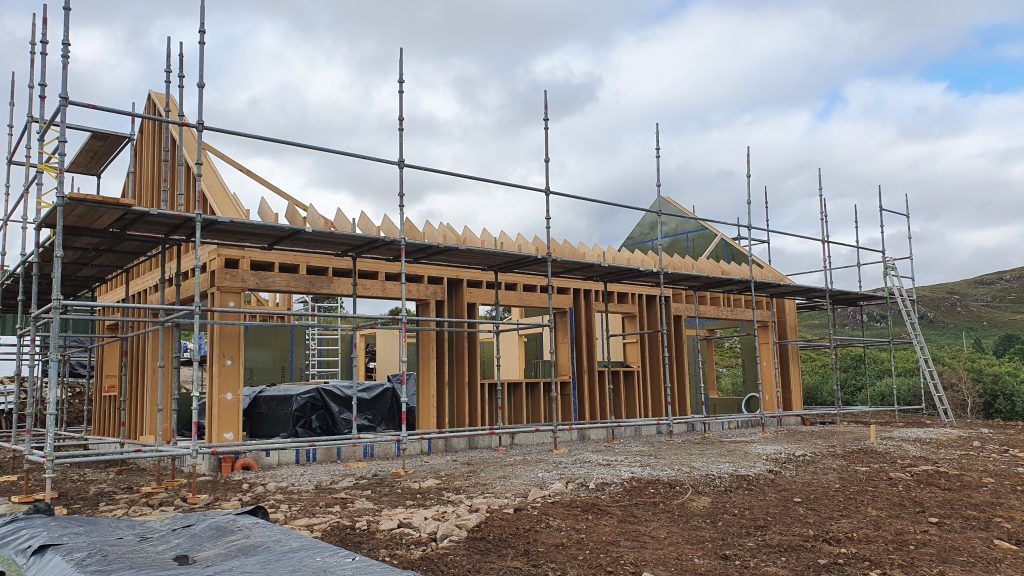
Kit build continues – not quite at the same heady pace as that first week, but we’re not too far off from starting on the roof. The scaffolding has gone up around the house this week in preparation.
House Components
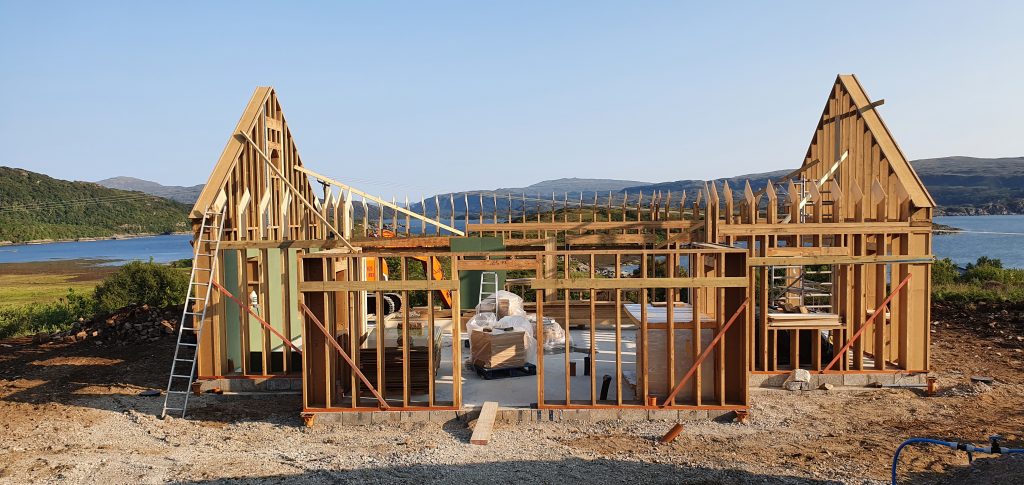
I’m slowly becoming more conscious – and educated – about the role played by each different part of the kit, and indeed all the materials themselves.
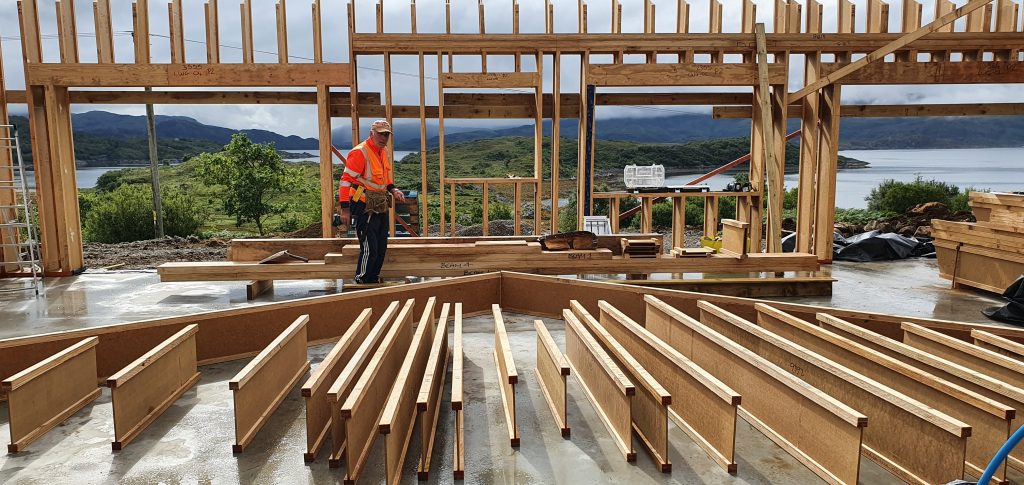
The i-joists for instance – which make up most of the structure of the house – in themselves look fairly unremarkable, but their value is in their strength relative to the equivalent weight of conventional timber. Whilst building with timber is the best material to use in terms of carbon impact, as with every solution to the climate crisis, reducing the amount of material we use is the absolute first principle.
The joists are fast and easy to install, pre-cut to size (reduces waste on site, construction time and margin for worker error), and they’re lightweight with high load-bearing capacity. Our i-joists are made by STEICO, and are part of a whole STEICO manufacturing system, in which they make use of every single part of the whole tree. At the moment, STEICO’s manufacturing facility is in Poland, so we do have transport impacts to take into account, but as timber is relatively lightweight compared to other materials, it’s currently a good solution compared with alternative building materials available in the UK.
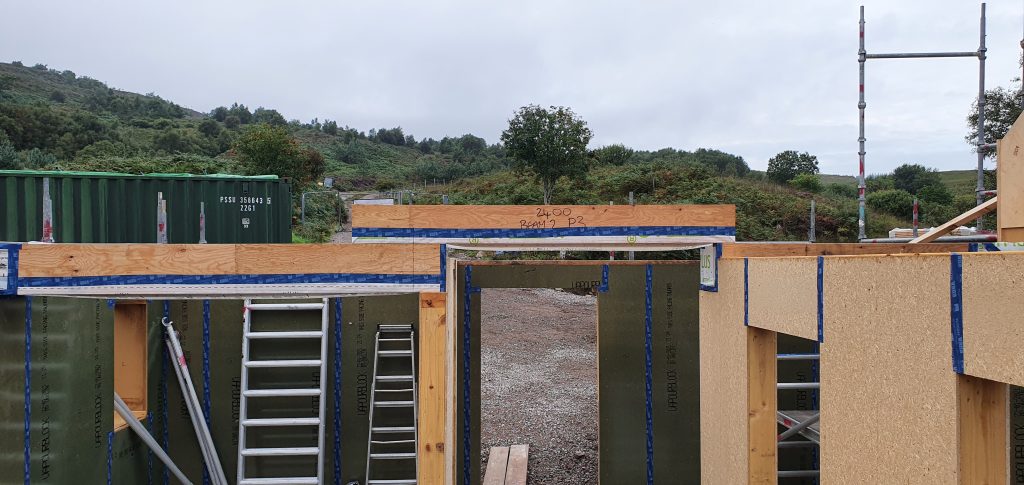
Another material that’s been pretty prominent over the past few weeks is wood fibre insulation – or ‘hairy board’. This is typically packed along the sides of the i-joists, particularly where 2 joists are installed next to or on top of each other, in spaces where blown-in insulation couldn’t get to. I would imagine this is the sort of product that is made from parts of the tree that in the past would have simply been discarded – but now it is processed and provides a very effective insulation material.
We also have natural wool insulation, which is used in the slightly more irregular small spaces and it also went into our internal bedroom stud walls this week. There was something absurdly pleasing about seeing this in the bedroom walls – just looking at it feels cosy! In these walls, its purpose is to provide a good sound barrier.
So whilst of course there are metal screws, a lot of tapes that ensure airtightness and various membranes/protective coatings, the vast majority of materials in the house – at least above the foundations – are natural and part of a circular, regenerative supply chain.
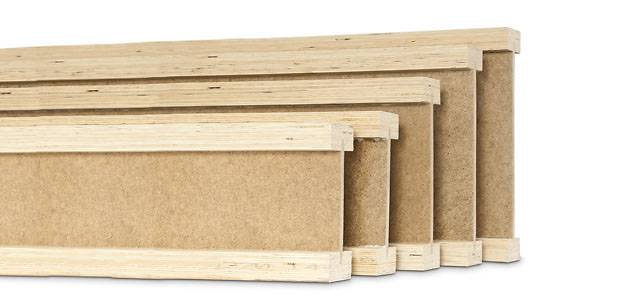
i-joists 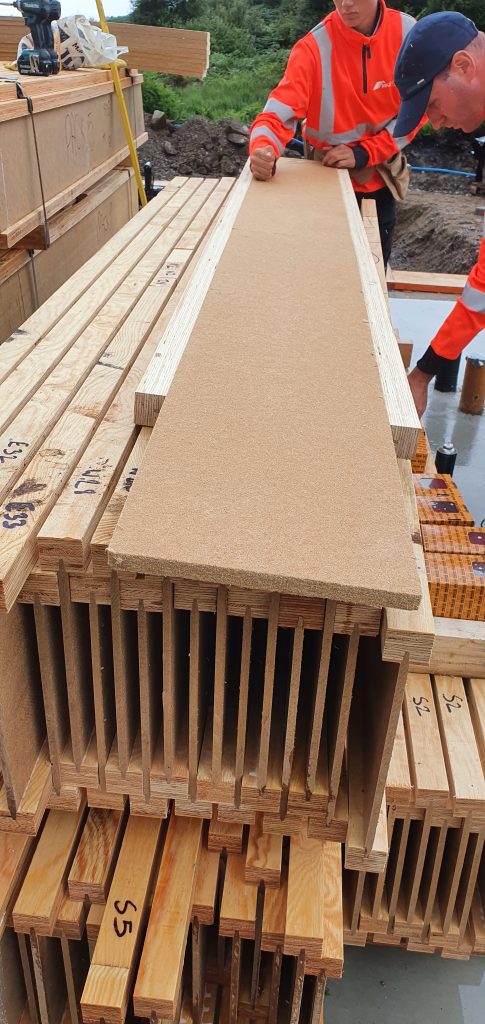
flexible wood fibre insulation 
wool insulation
Engineering Skills
To my latest skill admiration: building engineers. How they work out what combination of elements is required to ensure that the building stays up – and importantly to resist anything that our location will throw at us weather-wise – is a total mystery to me. And when you know that the brief for our house is also to minimise the use of materials, I really appreciate their expertise, and the materials science that goes into it. There have been quite a few times where builder Steve and I have looked at a particular detail and said “Why is it done like that?” but then I know I remember the pages of engineering calculations that I looked at (and skipped quite quickly by) and ultimately just trust that someone knows this stuff!
That said, there are lots of different structural engineers – and at the building control side of things, there are clearly some structural engineers who perhaps have simply been worn down by the tick-boxing nature of the building control process. Focus for many seems to be more about making sure a building will pass building control, in the easiest possible way, apparently seemingly regardless to cost, environmental and/or common-sense principles – and certainly not questioning the sometimes absurdity of a regulation.
There appears to me to be a huge opportunity within the construction sector to massively reduce the environmental impact and waste (and subsequent cost) by builders, architects, structural engineers and building control working together, by simply putting this environmental and waste lens on building control regulations. Building controls are absolutely necessary, but just taking the apparently easiest route that you know the building controller passed last time risks both not keeping up with latest innovation (our concrete being a case in point, as I talked about in an earlier blog) but also huge waste. We’ve just come up against another example of this: 14 manhole covers incorporated into the design of our external drainage layout. Fortunately, we had someone very experienced doing the drainage works for us who mentioned that it seemed excessive, and way more than he’d ever put into previous houses. And when I looked at the amount of plastic that had come onto site, and that would be dotted all around our house (very visibly), I went back and asked the question of the structural engineers who had designed that part. Manhole covers and inspection points were reduced immediately from 12 down to 6. I’m just very glad that I happened to be on site that day and asked the question (can’t say I’d spent much time really understanding the fairly uninteresting looking drainage drawing previously – my mistake!). I’m sure bigger developers would be challenging this sort of thing largely on cost grounds, but how much waste must go with this sort of process and people not questioning?