Thermal bridges are another of those things that can’t say I’d ever heard of or thought about before recently. One of the key principles of building a Passivhaus – or indeed any air tight house – is that you eliminate all thermal bridges. In this latest stage of the build Steve and I are beginning to understand a bit more about what those diagrams are talking about!
For the uninitiated (like us) according to the Zero Carbon Hub Thermal Bridging Guide:
a thermal bridge (sometimes referred to as a cold bridge) is a localised weakness or discontinuity in the thermal envelope of a building. They generally occur when the insulation layer is interrupted by a more conductive material.
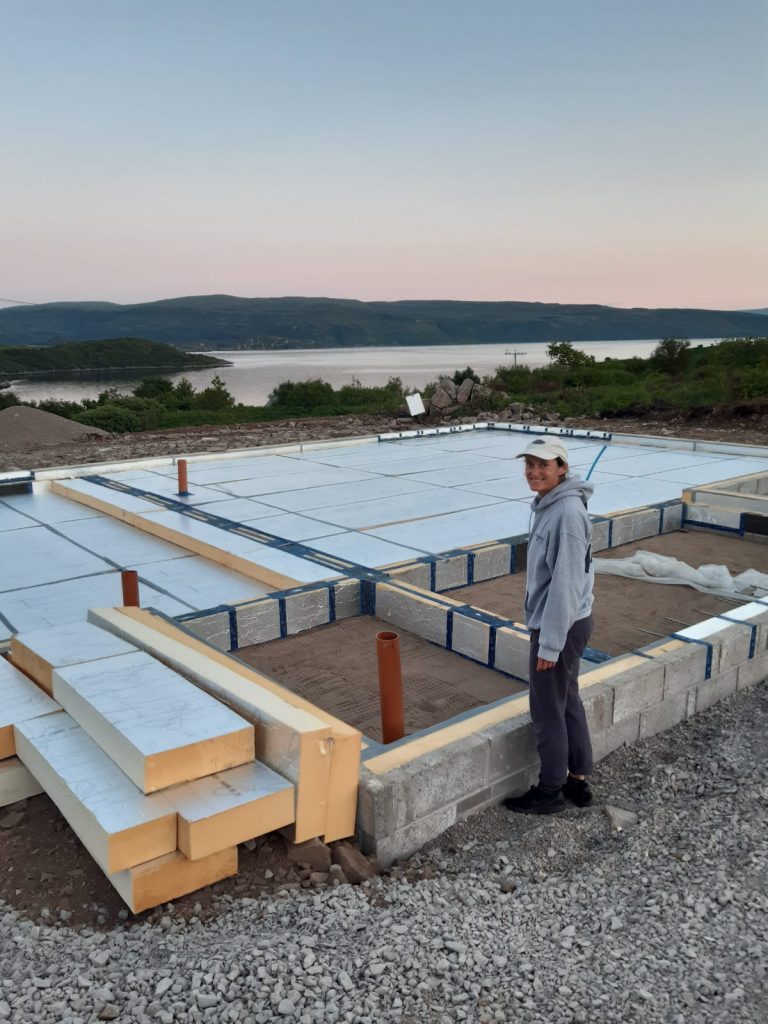
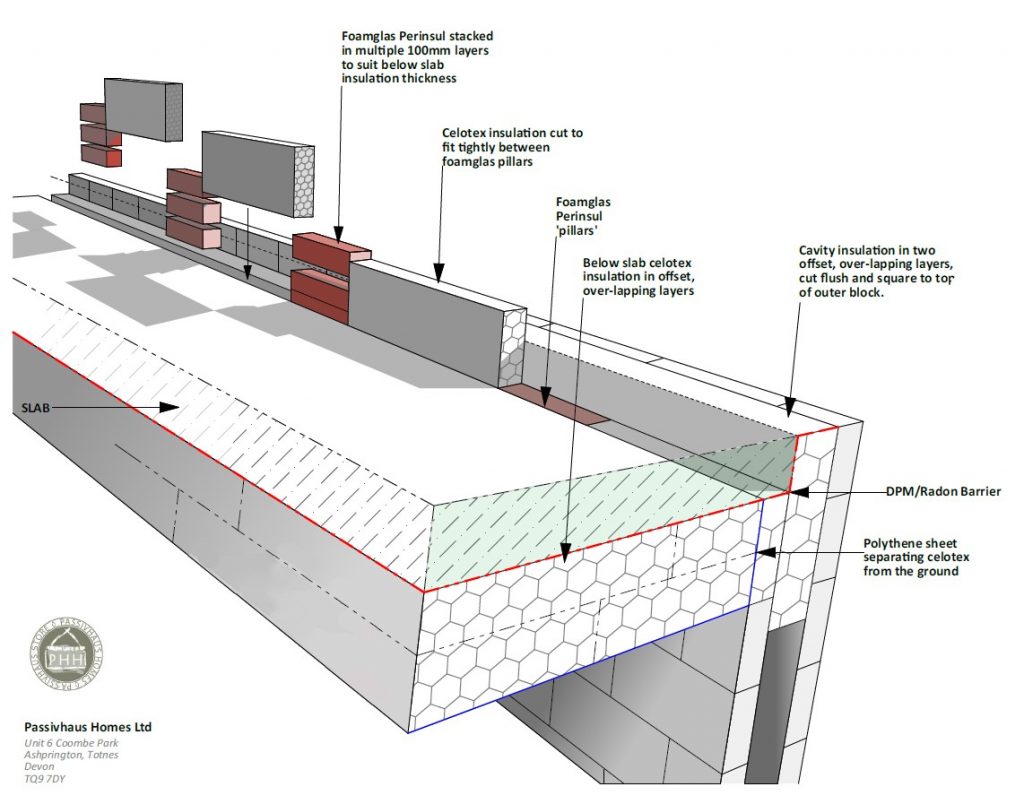
So very simply, for our foundations our concrete slab needs to be surrounded by insulation – below the slab (300mm of it) and to the side of it a 150mm thick wall of the same insulation. Needless to say, none of the build team had ever seen as much insulation put under a slab before!
Apart from the concrete slab itself, this ‘rigid PIR foam board’ thermal insulation on the face of it is the most apparently ‘evil’ in environmental terms of all the products in our build – being some sort of high density foam product made from polyurethane. It justifies inclusion though due to two key factors:
i. it provides great insulation properties per m3, in a way that equivalent non-fossil fuel based products (currently) can’t
ii. its insulating properties means that it saves many times over the amount of operational carbon of the house (the amount of carbon used for heating during the house’s life) compared to the embodied carbon that is used to make it.
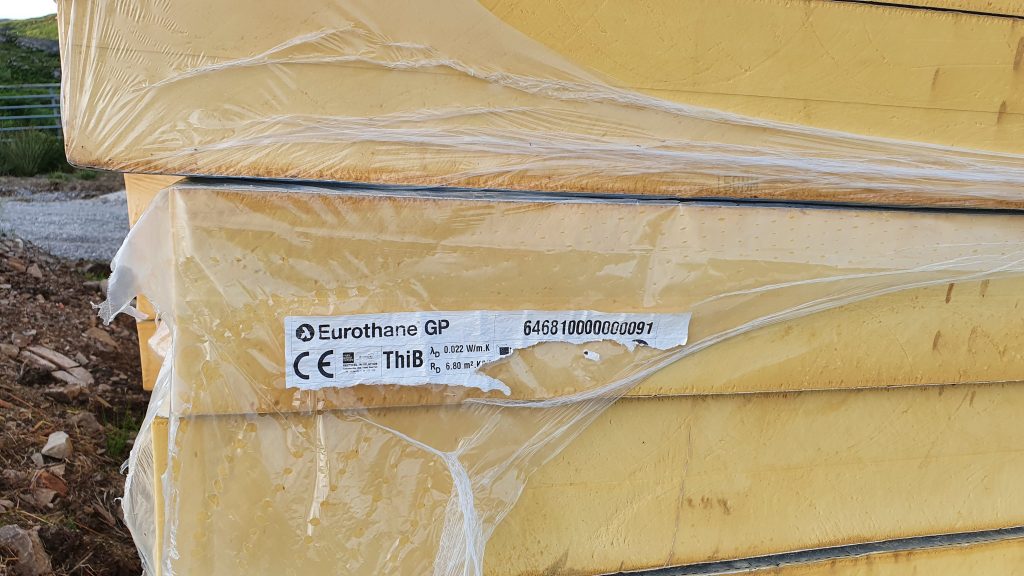
We are using a product called Eurothane GP made by Reticel. I did a bit of investigation initially through their website and wasn’t that encouraged they were at all invested in sustainability initiatives. However, when I spoke to the company directly I was reassured that sustainable innovation is a key driver in their group strategy, and they seem to be engaged in some interesting projects to make their products more circular in production and use – I now feel more comfortable about it being under our feet, and importantly keeping us warm!
In addition to the foam insulation, foamglas pillars are incorporated within the inner substructure walls providing additional support to the frame, whilst ensuring no thermal bridging. (As well as being made from 60% recycled materials, including from things like car windscreens, they are designed for longevity, to last the whole lifespan of the building itself).
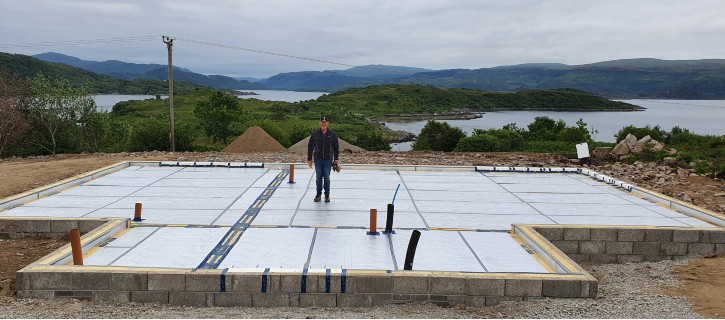
And now just ready for the final concrete for the slab!