
I appreciate that the vast majority of people won’t be that interested in this post. But if you don’t read any further, please just absorb this next fact, which explains the reason why concrete is so important and builders in particular need to pay attention:
Cement – the key ingredient in concrete – is the source of 8% of the world’s carbon dioxide emissions.
A comparator that is often used:
If cement was a country, it would be the third largest emitter in the world – behind China and the US.
It’s substantially more than aviation fuel, which accounts for 2.5% of the world’s CO2 emissions (and receives a lot of the media attention). So that’s why we had to look into it – as whilst the use of concrete in our build was essential, it has a significant impact on the amount of embodied carbon in our final building.
Fortunately, once again those experts working with us on our house build were way ahead – both architect Peter and Jonathan from Passivhaus Homes as a matter of course were ensuring as little concrete as possible was built into the design. The Passivhaus Planning Packing (PHPP) now includes a carbon ribbon and so Jonathan was very aware of the precise impact concrete would have in our net zero carbon ambition. In the very simplest terms, if we only consider the carbon used in manufacturing all the materials our house is built from, plus the capacity of those materials to store carbon (the A1-A3 category of impacts according to the UK Green Building Council net zero framework), without concrete our building would be a carbon store, as it’s made almost entirely from timber. Every cubic metre of concrete used therefore has a significant impact in overturning that ‘store’ status.
Of course concrete is also a great material. I’ve joined enough webinars about concrete to appreciate its value. And from those same webinars, I have also heard – and been reassured – about the focus that all cement companies are now putting on lower carbon products. The capability to produce lower carbon concrete seems to have been around for quite a long time, but until very recently the building industry hasn’t considered the embodied carbon in concrete a significant enough issue for them to be bothered to change how they do things. Things are beginning to change… albeit slowly, and also lots of innovation is on its way.
Hanson ReGen Concrete
Quite a while ago, Peter sent through the brochure for a new lower carbon concrete that Hanson Concrete were selling and marketing, called ReGen. The idea that this product would be available in the Highlands when we wanted to use it didn’t seem very likely, but at least I was reassured that it was becoming available in the market generally. It was only when we began to talk to our building contractor, Steve Faryma, about the details of our groundworks, and Peter mentioned that they had used the Hanson product on a recent project, that I thought there was no harm in just checking if there was any chance of us using it. Concrete specification doesn’t tend to be one of those items that clients generally get very involved with in a build (!), but to his credit, Steve was happy for me to speak to the local concrete suppliers in Fort William to discuss it with them (there are only two, so it wasn’t too big a task).
I spoke to two very nice, helpful people who picked up the phone at the two different companies – neither had heard of ReGen concrete, and both were clear that wasn’t something they did or indeed could do, as they were small plants with only a single hopper. Fortunately both of them did give me the number of a more technical person to speak to (perhaps to get me off their backs, and stop me rambling on about why they should be interested in selling a lower carbon product!). One of these people was Stephen Stewart, Leith’s Concrete General Manager.
Stephen Stewart immediately confirmed that actually Leith’s in Fort William did supply the ReGen product and it wouldn’t be an issue for us to have it, we just needed to give a few more days’ notice than the standard mix, but it wasn’t a big deal. The product had been supplied previously for its strength properties rather than the lower carbon characteristics, and hence why the person I initially spoke to from Leith’s hadn’t recognised my description. Stephen also confirmed that in terms of price, it was pretty much the same cost as normal concrete and the only slight difference is that it takes slightly longer to set, but for most purposes this wouldn’t be noticeable. So far, so good! I relayed this back to Steve Faryma and his response was a very positive “Why wouldn’t everyone use this product? Seems a no-brainer.” Indeed.
However, in an industry that revolves around a lot of regulations, expensive structural engineering drawings, and general reluctance (by everyone) to do things slightly different than how they’ve been done for a long time, there were still a few hoops to go through.
It would have been very easy for me to just say this is too hard when I was, for example, asked by the structural engineer about the concrete mix (what do I know about concrete?!), it was suggested that building control might not be happy and could result in needing to go back to building warrant stage (oh my goodness!), and various ‘rumours’ from people who had used concrete in the past with a recycled element (as ReGen has) and didn’t rate it, or others who had used ReGen and it hadn’t set for ages. Like most things, everyone – including me – needed to be educated. Thankfully Stephen Stewart was extremely patient answering all my questions!
So here are the facts:
- There was absolutely no issue with the mix from either structural engineering or building warrant point of view. The structural engineers had specified a C35 concrete mix, and that is what was delivered – it just uses GGBS (Regen) as part of the cementitious content
(GGBS = Ground Granulated Blast Furnace Slag, is a cement substitute, manufactured from the by-product of the iron-making industry). - ReGen concrete does take slightly longer for the initial set, but from the builders’ perspective, when the concrete was poured in our foundations, they didn’t notice any difference compared with the concrete they usually deal with
- Strength development of the concrete is slower when using GGBS – achieving 50% strength after 7 days, and whilst it is designed to be compliant to 28-day strength measures, it will continue to strengthen beyond 28 days (up to 56 days).
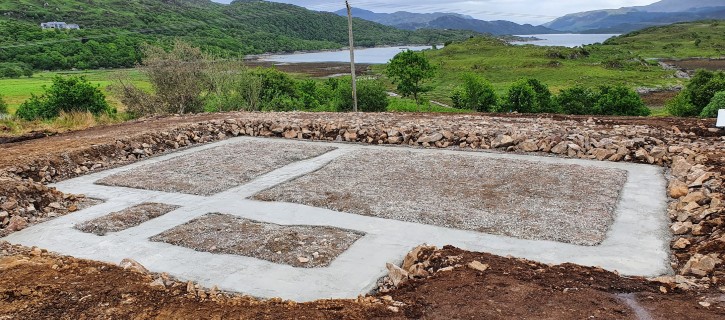
For individual house builds such as ours, this increase in strengthening time has no noticeable impact – the morning after our foundations were poured, the concrete was very solid, and would have been no problem to have started blockwork. (But for those more knowledgeable, here are the numbers for the early strength development: you should get 5N/mm2 at 1 day, 10N/mm2 at 3 days) - A lot of different factors play a part in concrete setting times and strength development, including: the precise aggregates that have been used, the retardants added to the mix (to slow the setting down if the concrete has to travel some distance to site), the depth of the concrete (thicker concrete will generate more heat and potentially set quicker), and the air temperature (sets much quicker in warm weather than cold). The incorporation of GGBS is just another factor to take into account
- BUT MOST IMPORTANTLY: USING A MIX WHICH INCORPORATES 50% GGBS REDUCES THE CO2 / KG OF THE PRODUCT BY 50% – SO IN OUR CASE WE WILL HAVE SAVED 8.3 TONNES OF EMBODIED CARBON IN OUR BUILDING (ONCE THE HOUSE SLAB IS INSTALLED IN A COUPLE OF WEEKS).
Ultimately, post pour, it remains as Steve Faryma stated at the start, a total no-brainer. All builders should be looking to use this. We’ll certainly be flying the flag for it.